


The figures, examples, and brand names in this article are illustrative. IsoHiTech is an independent supplier of lubrication components and is not affiliated with the OEMs or third-party brands mentioned.
Guide vs solutions page: This post explains types, ROI, and installation for automatic lubrication. Product families, pump lines, and quote paths live on the commercial hub: automatic lubrication solutions. Centralized architecture comparison is on the centralized lubrication systems hub.
 An automatic lubrication system (ALS) delivers controlled amounts of lubricant to machinery bearings, chains, gears, and other friction points at scheduled intervals without manual intervention. Reported field results vary widely, but many operators observe reduced manual greasing labor, longer bearing life, and fewer lubrication-related stoppages when systems are correctly specified, installed, and maintained.
This guide covers how automatic lubrication systems work, compares the four main architectures, and provides engineering selection, installation, troubleshooting, and maintenance guidance. Quick navigation: See the Lubrication System hub for the fundamentals of centralized lubrication.
Contents
- What Is an Automatic Lubrication System?
- ROI Considerations: Is an Automatic Lubrication System Worth It?
- Lubricant Standards for Automatic Systems
- Which Industries Use Automatic Lubrication Systems?
- The Different Types of Automatic Lubrication Systems
- Single-Line Systems
- Dual-Line Systems
- Positive Displacement Injector Systems
- Progressive Systems
- Single-Point vs Centralized Systems
- How to Choose the Right Automatic Lubrication System
- Installation Requirements and Best Practices
- Troubleshooting Guide: Common Issues and Solutions
- Maintenance Best Practices
- Pros and Cons of Automatic Lubrication Systems
- People Also Ask
- Frequently Asked Questions
- Conclusion
What Is an Automatic Lubrication System?
An automatic lubrication system is an engineered assembly that supplies lubricant to machine components without manual intervention. A typical centralized ALS consists of a reservoir, pump, controller, metering devices, distribution tubing or hose, and monitoring sensors. The controller initiates lubrication cycles based on time, machine operation, or condition signals; the pump moves lubricant through the distribution network; and metering devices ensure each point receives the correct quantity. The main benefits of using an automatic lubrication system include:- Reduced downtime due to fewer manual lubrication tasks
- Improved safety by minimizing exposure to moving machinery
- Consistent lubricant application, reducing over- and under-greasing
- Extended bearing and component life
- Lower total maintenance cost over the system lifecycle
Automatic Lubrication System Components and Working Principle
Understanding how the components work together is essential for proper implementation. A centralized ALS can supply many points from one reservoir and pump, which is why it is widely used on heavy equipment and fixed industrial machinery. Typical Operation Cycle:- Timer/Sensor Activation: System initiates lubrication cycle
- Pump Operation: Draws lubricant from reservoir
- Distribution: Lubricant flows through distribution lines
- Metering: Precise amounts delivered to each lubrication point
- Monitoring: System confirms successful lubrication
- Reset: Cycle resets for next scheduled lubrication
ROI Considerations: Is an Automatic Lubrication System Worth It?
Before selecting a system, engineers usually ask whether automation will deliver measurable financial return. No manufacturer or industry body publishes a universal payback figure; actual return depends on labor rates, machine utilization, failure history, and system complexity.What is documented: no manufacturer or industry body publishes universal payback or savings percentages for automatic lubrication. The strongest published number behind the decision is SKF’s attribution of roughly 36% of premature bearing failures to poor lubrication practices — over 56% when contamination is added — which is the failure mode automatic lubrication removes. Everything else depends on point count and site costs, so calculate payback from your own manual-greasing labor hours, downtime cost per stop, and bearing replacement cost.
Lubricant Standards for Automatic Systems
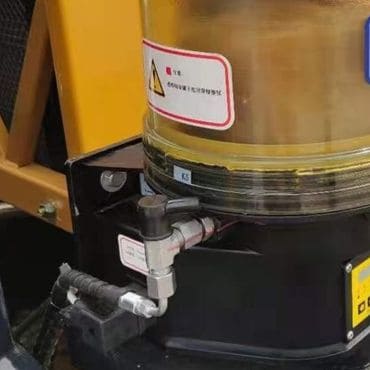 Automatic lubrication systems rely on lubricants that meet defined consistency, viscosity, and compatibility specifications. The three most common specification frameworks are NLGI, ISO VG, and OEM/machine-builder standards. NLGI Grease Consistency Grades (most common for grease ALS):
- NLGI Grade 0-1: Low temperature, high-speed applications
- NLGI Grade 2: General purpose, most common choice
- NLGI Grade 3: High temperature, slow-speed applications
- ISO VG 32-68: General industrial bearings and gears
- ISO VG 100-220: Medium-load gearboxes and large bearings
- ISO VG 320-680: Heavy-duty open gears and slow-speed bearings
- OEM lubricant approvals and recommended regreasing intervals
- Food-grade NSF H1 requirements for food processing
- Marine/ offshore corrosion-protection standards
- Extreme-pressure (EP) and anti-wear (AW) additive packages
Which Industries Use Automatic Lubrication Systems?
Automatic lubrication systems are used across any industry where continuous operation, safety, and maintenance cost control matter. Common sectors include mining, construction, steel, cement, food processing, wind energy, marine, and general manufacturing.Industry-Specific Applications
In construction fleets, ALS units are common on excavators, bulldozers, and cranes. Mining operations use them on haul trucks and conveyors to reduce downtime in remote locations. Manufacturing lines use centralized or single-point systems to keep production equipment running with minimal interruption.Heavy Equipment and Fleet Applications
Heavy equipment and commercial fleets operate in dusty, high-vibration environments where manual greasing is time-consuming and hazardous. Automatic lubrication systems for trucks, excavators, haul trucks, and conveyors deliver grease while the machine operates, keeping critical pivot points, bearings, and bushings properly lubricated. Typical Fleet Benefits:- Reduced need for daily manual greasing routines
- Extended component life on pins, bushings, and bearings
- Reduced contaminant ingress through consistent grease collars
- Better resale value due to improved maintenance records
Food, Marine, and Offshore Applications
Food Industry Automatic Lubrication
Food grade automatic lubrication systems meet stringent hygiene requirements while providing reliable food processing equipment lubrication automation. These systems use NSF H1 registered lubricants and stainless-steel components where required.Marine and Offshore Applications
Marine automatic lubrication systems withstand harsh saltwater environments, making them widely used for offshore equipment automatic grease systems. Corrosion-resistant materials, sealed reservoirs, and IP66/IP67 protection are typical requirements.The Different Types of Automatic Lubrication Systems
The most common industrial ALS architectures are:- Single-line resistance (SLR) systems
- Dual-line systems
- Positive displacement injector (PDI) systems
- Progressive systems
Single-Line Systems
 Single-line resistance (SLR) systems are among the most common automatic lubrication architectures for light- to medium-duty machinery. A pump delivers lubricant through a single supply line; calibrated restrictors or metering valves at each outlet create the pressure differential needed to dispense controlled amounts to each point. Technical Specifications:
- Maximum points: 5-20 typical
- Accuracy: ±5%
- Small to medium machinery
- Applications with similar lubrication requirements
- Budget-conscious installations
- Sequential operation; one blocked point can affect others
- Limited pressure and distance capability
- Less suitable for critical or high-speed machinery
Dual-Line Systems
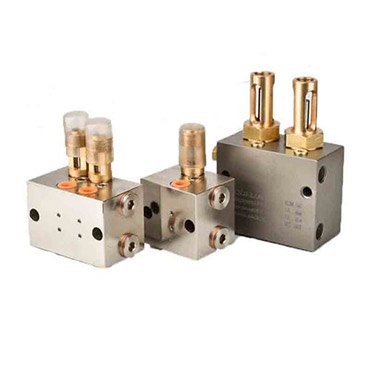 Dual-line systems are a common choice for heavy-duty, large-scale installations. Two main supply lines alternate between pressure and vent cycles. While one line pressurizes and supplies lubricant, the other vents, allowing fresh grease to fill the distribution network before the next cycle. Technical Specifications:
- Pressure range: 50-400 bar
- Maximum points: 500+
- Maximum distance: 100+ meters from pump
- Cost range: $10,000-100,000+
- Heavy industrial applications
- Large machinery with many lubrication points
- Harsh environmental conditions
- Critical equipment where reliability is paramount
- Fault tolerance through independent line operation
- Easy to expand by adding new lubrication points
- High-pressure capability for long distribution lines
- Reliable in contaminated and high-vibration environments
Positive Displacement Injector Systems
 Positive displacement injector (PDI) systems use individual injectors at each lubrication point. A central pump pressurizes a single supply line; when line pressure reaches the injector opening pressure, each injector discharges a fixed, pre-set volume of lubricant. Because each injector operates independently, PDI systems offer precise point-by-point control and easy monitoring. Technical Specifications:
- Maximum points: 500+
- Accuracy: ±2%
- Medium to large machinery with varying point requirements
- Applications requiring individual point monitoring
- Systems where point access is difficult
- High metering accuracy per point
- Electronic cycle feedback available
- Individual injectors can be adjusted or replaced without affecting others
- Long service life with proper maintenance
Progressive Systems
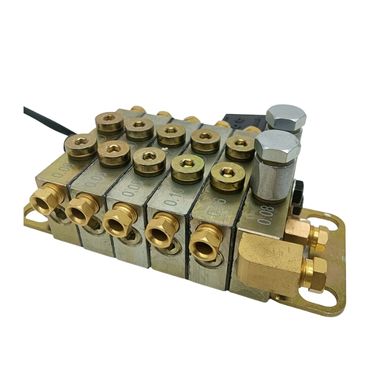 Progressive lubrication systems use a series of interconnected metering pistons within a progressive divider block. When the pump pressurizes the line, the first piston discharges and mechanically forces the next piston to move, creating a sequential chain reaction. The system cannot complete a partial cycle; if one outlet is blocked, the entire sequence stops, providing positive feedback through a cycle indicator or pressure switch. Technical Specifications:
- Maximum points: 100+ typical
- Accuracy: ±10%
- Medium to large machinery
- Applications requiring precise metering
- Systems with 6-50+ lubrication points
- Grease-lubricated equipment in harsh environments
- Positive displacement ensures complete distribution
- Visual indicators provide immediate cycle confirmation
- Excellent performance in contaminated environments
- Cost-effective for grease applications
Single-Point vs Centralized Systems
A single-point automatic lubricator serves one bearing or lubrication point, typically using a spring, gas, or electromechanical dispenser. Centralized systems use one pump and controller to feed many points through a distribution network.| Factor | Single-Point Lubricator | Centralized ALS |
|---|---|---|
| Point Count | 1 per device | 5 to 500+ |
| Initial Cost | Device-level pricing | Project-level pricing (quoted per system) |
| Maintenance | Replace/refill each unit | Service one reservoir and pump |
| Best Use | Remote or single critical bearings | Multiple points on one machine or plant |
How to Choose the Right Automatic Lubrication System
 Selection starts with five application parameters: number of lubrication points, operating environment, lubricant type, duty cycle, and budget. Each architecture has a practical operating envelope. Selection Logic:
- 1-5 points, simple machine: Single-point lubricators or compact single-line systems
- 5-20 points, light/medium duty: Single-line resistance systems
- 10-100 points, medium/heavy duty: Progressive systems
- 20-500+ points, varying requirements: PDI systems
- 50-1000+ points, critical heavy industry: Dual-line systems
System Selection Decision Matrix
| Factor | Progressive | Single-Line | Dual-Line | Injector |
|---|---|---|---|---|
| Cost | Medium | Low | High | High |
| Complexity | Medium | Low | High | Medium |
| Capacity | Medium-High | Low-Medium | High | Medium |
| Monitoring | Good | Basic | Excellent | Excellent |
Installation Requirements and Best Practices
Proper installation ensures long-term reliability. The same fundamentals apply whether the system is on mining equipment, construction machinery, or a fixed production line. Pre-Installation Checklist:- Confirm lubricant compatibility with seals, hoses, and metering devices
- Calculate total system pressure losses including line length, fittings, and elevation
- Verify electrical supply, control signals, and sensor inputs
- Plan reservoir location for clean refill access
- Install filtration at the pump inlet where required
- Route distribution lines away from heat sources and pinch points
- Use vibration-rated clamps and supports
- Label every lubrication point and line for future maintenance
- Commission the system gradually, verifying each point receives lubricant
- Document baseline pressure, cycle time, and metering settings
Troubleshooting Guide: Common Issues and Solutions
- Empty reservoir
- Clogged distribution lines
- Pump failure
- Controller malfunction
- Check reservoir level
- Inspect lines for blockages
- Test pump operation
- Verify controller settings
- Blocked distributors
- Pressure imbalances
- Worn metering devices
- Air in system
- Clean distributors
- Balance pressures
- Replace metering devices
- Bleed air from system
- Over-lubrication settings
- System leaks
- Wrong grease grade
- Faulty metering
- Adjust schedules
- Inspect for leaks
- Verify grease compatibility
- Calibrate meters
Maintenance Best Practices
| Frequency | Task | Time Required | Critical Points |
|---|---|---|---|
| Daily | Visual reservoir level check | 2 minutes | Check operation indicators, obvious leaks |
| Daily | Verify system operation | 3 minutes | Listen for pump operation, check displays |
| Weekly | Detailed leak inspection | 15 minutes | Check all connections and distribution lines |
| Weekly | Clean external components | 10 minutes | Remove dirt and debris from pump unit |
| Monthly | Filter replacement | 30 minutes | Replace inlet filters, check for contamination |
| Monthly | Controller testing | 20 minutes | Test all alarms and sensors |
| Annual | Complete system overhaul | 4-8 hours | Replace wear parts, software updates |
Pros and Cons of Automatic Lubrication Systems
Pros:- Reduced downtime due to less need for manual greasing
- Lower maintenance costs due to less wear on equipment
- Improved safety due to less exposure to grease and chemicals
- Consistent lubricant quantity and timing
- Better contamination protection through controlled grease collars
- Higher initial investment than manual lubrication
- Requires skilled installation and commissioning
- Needs periodic maintenance and monitoring
- System failures can affect multiple points simultaneously
People Also Ask
What is an automatic lubrication system?
An automatic lubrication system is an engineered assembly that supplies lubricant to machine bearings, gears, chains, and other friction points on a set schedule without manual intervention. See the definition section for a detailed explanation.How does an automatic lubrication system work?
A controller or sensor starts a cycle, a pump draws lubricant from a reservoir, and metering devices deliver measured amounts to each point through distribution lines. The components and working principle section describes the full cycle.What are the types of automatic lubrication systems?
The four main industrial architectures are single-line resistance, dual-line, positive displacement injector (PDI), and progressive systems. Each is compared in the system types section.What is the typical ROI of an automatic lubrication system?
Reported payback periods commonly fall in the 12-24 month range, with labor, downtime, and lubricant savings varying by application. See ROI considerations for typical ranges.Which industries use automatic lubrication systems?
Common sectors include mining, construction, steel, cement, food processing, wind energy, marine, and general manufacturing. The industry applications section lists examples.Frequently Asked Questions About automatic lubrication system
What industries use automatic lubrication systems?
Automatic lubrication systems are used in mining (excavators, haul trucks), construction (cranes, concrete pumps), steel manufacturing (rolling mills), wind energy, port equipment, food processing, and CNC machine tools.How much can automatic lubrication save?
No manufacturer publishes a universal savings percentage. The well-documented number is the failure mode automatic lubrication removes: SKF attributes around 36% of premature bearing failures to poor lubrication practices — over 56% when contamination is added. Calculate ROI for your site from manual-greasing labor hours, downtime cost per stop, and bearing replacement cost.What is the typical price of an automatic lubrication system?
There is no universal price range. Cost scales with architecture and point count: single-point lubricators are individual devices for a few points, while single-line, progressive, PDI, and dual-line systems are engineered and quoted per project — installation, commissioning, and site-specific engineering are additional. Budget from quotations for your specific point count and layout.What pressure can automatic lubrication systems handle?
Working pressure is set by each manufacturer’s component ratings, not by architecture category: SKF rates its progressive feeders up to 300 bar with pump units reaching higher, and Graco lists 3,500 psi (≈241 bar) for complete single-line systems. Select by the datasheet of the specific pump, feeder, and injector model, not generic range tables.How long do automatic lubrication systems last?
With proper maintenance, pumps and controllers commonly last 10+ years. Distributors, injectors, and progressive blocks can last 5-10 years depending on operating environment and lubricant cleanliness.What is the delivery time for a complete automatic lubrication system?
Standard packaged systems are typically available in 2-4 weeks. Custom engineered systems with large distribution networks may require 6-10 weeks for design, procurement, and factory testing.Do manufacturers provide installation support?
Most industrial ALS suppliers provide installation manuals, wiring diagrams, and remote technical support. On-site commissioning support is usually available for large or critical projects.What communication options do modern controllers have?
Common controller interfaces include 24V DC outputs, relay outputs for PLC integration, RS485/Modbus RTU communication, and optional IoT/ cloud monitoring modules for remote diagnostics.Can one automatic lubrication system use both oil and grease?
Generally no. A single ALS is designed for one lubricant type because oils and greases require different pumps, metering devices, and distribution pressures. Multi-line systems can handle different lubricants only when each line is fully isolated.What is the difference between centralized and single-point lubrication?
Centralized systems use one pump and controller to serve many points through a distribution network. Single-point lubricators are self-contained units mounted directly on one bearing or lubrication point.How is it decided whether an application needs automatic lubrication?
Applications with many hard-to-reach points, high downtime costs, harsh environments, or strict safety requirements often justify automatic lubrication. Feasibility is usually confirmed with an ROI calculation that compares manual labor cost, downtime cost, and expected equipment-life extension.What happens at the bearing during each lubrication cycle?
The injector delivers a small metered dose through the fitting; fresh lubricant displaces aged lubricant across the rolling elements and rebuilds the sealing grease collar at the housing. Because each cycle replaces only a small volume, the bearing runs on fresh lubricant continuously instead of cycling between over-greased and starved states.Is a centralized grease lubrication system worth the cost?
The strongest published number behind the decision: SKF attributes around 36% of premature bearing failures to poor lubrication practices — over 56% when contamination is added (SKF). That is the failure mode automatic lubrication removes. Against it, weigh the installed cost, commissioning, and upkeep for your point count: SKF positions single-point lubricators as a low-to-medium investment for a few points, and centralized systems for many points served from one pump through metering devices. Since no manufacturer publishes a universal payback figure, run the calculation for your site: manual-greasing labor hours, downtime cost per line stop, and bearing replacement cost.
Single-point lubricators vs. a centralized system: which fits your machine?
Follow point count and access. SKF describes single-point lubricators as suited to “only a few” points and difficult-to-access positions, and centralized systems where many points share one pump and distribution network. Published hardware specifics: SKF SYSTEM 24 (LAGD 125) holds 125 ml adjustable over 1–12 months; NTN lists READY 60/125 cc, SMART 65/130 cc, and DRIVE 60/120/250 cc models, all 1–12 months; perma’s FLEX comes in 60/125 cm³ with catalogue units up to 500 cm³ (maximum 6-month discharge) (SKF; NTN; perma). NTN positions SMART for wide temperature swings and DRIVE for high ambient heat and severe vibration. No source publishes a break-even point count, so size by layout and access, not a rule of thumb. Our centralized system implementation guide covers the multi-point side in depth.

