



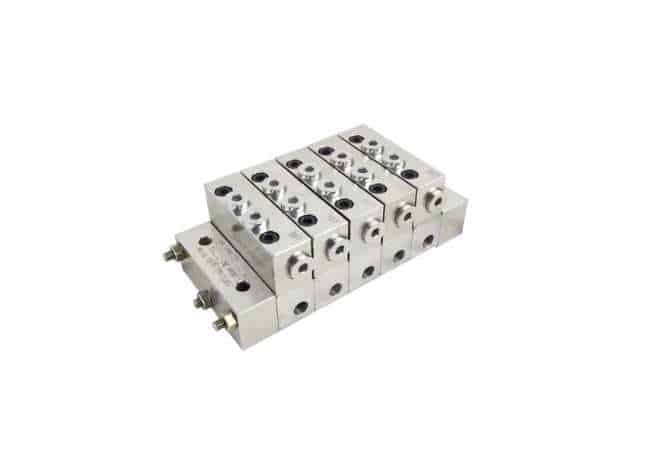
DJF2500 Block
The DJF2500 progressive distributor block meters grease or oil in strict sequence on one supply line—each piston slice must complete before the next advances. Built in steel with zinc plating and Viton O-rings for higher temperature duty than compact aluminum 1000-series blocks, with modular slices you can add or replace without removing all tubing.
Max working pressure: 25 MPa. Discharge: 0.08–1.28 ml/cycle per outlet (size code 5–40, T/S dependent). Lubricants: oil ≥ ISO VG 68; grease NLGI #000–#2. Temperature: -20°C to +60°C. Stacks use 3–10 working slices for up to 20 lubrication points per assembly chain. Cycle indicator pin or electromechanical switch confirms full progression—if one slice blocks, downstream points stop receiving lubricant.
Series: DJF1000 (16 MPa, compact aluminum) · DJF2000 (25 MPa, carbon steel) · DJF3000 (25 MPa, highest ml/cyc) · progressive hub · progressive systems.
- DJF2500 Features
- DJF2500 Technical Summary
- Size Codes — P/N 22500 (T = twin, S = single)
- Product Video
- Viton O-rings — higher temperature tolerance than standard NBR in light-duty blocks
- Modular steel slices — add, replace, or resize sections without disconnecting every tube run
- Visible cycle indicator — pin travel confirms full stack progression each pump cycle
- Cross-port kits — P/N 32265-3 for line crossover on complex machine layouts
- Brand-neutral interface — common progressive logic; pairs with CS, CSK, FS, and electric stations on Related Products
| Parameter | Value |
|---|---|
| Max working pressure | 25 MPa |
| Delivery per outlet / cycle | 0.08–1.28 ml/cyc |
| Material | Steel, zinc-plated |
| Seals | Viton |
| Working slices | 3–10 |
| Points per group | 3–20 |
| Max frequency (with cycle pin) | 60 cyc/min |
| Max frequency (without pin) | 200 cyc/min |
| Outlet tube | Φ6 mm (1.2–3.5 m typical) |
| Inlet / secondary | Φ8 mm (1.5–4.5 m typical) |
| Fill filter (grease) | 150 μm recommended in dusty plants |
| Size | Twin mL/cyc | Single mL/cyc | Twin P/N | Single P/N |
|---|---|---|---|---|
| 5 | 0.08 | 0.16 | 22500-05T | 22500-05S |
| 10 | 0.16 | 0.32 | 22500-10T | 22500-10S |
| 15 | 0.24 | 0.48 | 22500-15T | 22500-15S |
| 20 | 0.32 | 0.64 | 22500-20T | 22500-20S |
| 25 | 0.41 | 0.82 | 22500-25T | 22500-25S |
| 30 | 0.49 | 0.98 | 22500-30T | 22500-30S |
| 35 | 0.57 | 1.14 | 22500-35T | 22500-35S |
| 40 | 0.64 | 1.28 | 22500-40T | 22500-40S |
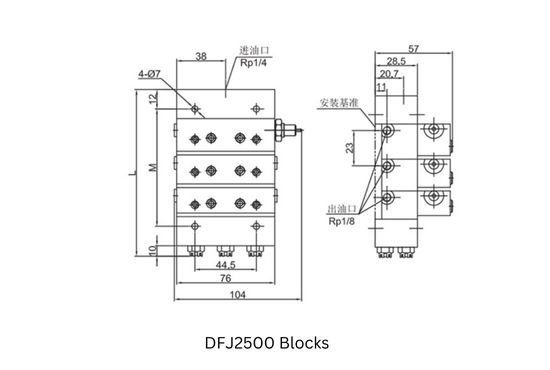
Stack Length vs Slice Count (mm)
| Slices | M | L | Slices | M | L |
|---|---|---|---|---|---|
| 3 | 91 | 122 | 7 | 185 | 215 |
| 4 | 114 | 145 | 8 | 208 | 239 |
| 5 | 138 | 169 | 9 | 231 | 262 |
| 6 | 161 | 192 | 10 | 255 | 285 |
DJF Series Comparison
| Series | Body | Pressure | ml/cyc range | Min twin dose |
|---|---|---|---|---|
| DJF1000 | Aluminum | 16 MPa | 0.08–0.48 | 0.08 |
| DJF2000 | Carbon steel | 25 MPa | 0.16–1.12 | 0.16 |
| DJF2500 (this page) | Steel, zinc-plate | 25 MPa | 0.08–1.28 | 0.08 |
| DJF3000 | Carbon steel | 25 MPa | 0.4–4.8 | 0.4 |


How to order DJF2500 series distributors?
Example 2: Sketch of DJF-2500 distributor ordering
A: Indicate the type: DJF-2500;
B: indicates the number of sections (4 in this case)
C: indicates cycle indicator 8: micro switch type cycle indicator
D: contents in parenthesis indicate the sizes of sections after the first sections listed according to their sequence
E. The size of the first sections in the sequence is 35.T indicates twin outlets, and 8R shows that series 8 indicators are at the right end face of the sections.
F. The size of the second section in the sequence is one on the front left side of the sections. CF placed before size 15 shows that the cross port is on the left side; if placed after size 15, it will be on the right side.
G. The size of the third section in the sequence is 15. SR indicates s
H. Size of the 4th section is 10. T indicates a twin outlet.
Main Parameter
- Max work pressure: 25 MPa
- Delivery: 0.08 ml/cyc ~ 1.28 ml/cyc
- Lubricant viscosity (under standard temperature): oil ≥ N68, grease: NLGI 000# ~ 2#
- Work temperature: -20℃ to +60℃
- Max work frequency (with stem): 60 cyc/min
- Max work frequency (without stem): 200 cyc/min
- Manifold number: 3–10
- Outlet: Φ6mm length: 1.2~3.5m Φ8mm length: 1.5~4.5m

Accessories
Crosspost
| P.N. | Description | A (mm) | B (mm) | 2-d |
| 32265-1 | 1000 cross port kit | 19 | 15 | 2-G1/8 |
| 32265-2 | 2000 cross port kit | 22 | 21 | 2-M8 |
| 32265-3 | 2500 cross port kit | 22 | 21 | 2-M8 |
Electro-mechanical switch
The electromechanical switch is a device to monitor the flow of lubricant in the system. It uses the reciprocal movement of the indicator pin on the progressive distributor’s piston to enable the electro-mechanical switch’s opening or closing inside the cycle indicator to send electric signals to the host control system. Once an abnormality occurs in the lubrication system, the host control system will be able to send an alarm or stop the operation of the host to facilitate timely maintenance.
Contact capacity: 250VAC 1A or 125VAC 3A
Related Product
How DJF2500 Progressive Metering Works
Grease or oil enters the inlet (first) slice and advances pistons slice by slice through the stack. Each working slice discharges a fixed volume through its T (twin) or S (single) outlets only after upstream sections complete their stroke—this is progressive (series) logic, not parallel PDI firing. One full movement of the cycle indicator pin (or one pulse from a type 8 electromechanical switch) confirms that every connected point on that stack received its dose for that pump run.
If one bearing line blocks, lubricant cannot pass and the chain stalls. Line pressure rises; the indicator stops; the host controller should alarm on missing cycle signal within the timeout window. That fail-safe behaviour is why machine-tool and industrial OEMs prefer progressive blocks over open header systems where a blocked point may go unnoticed.
Typical Plant Layout
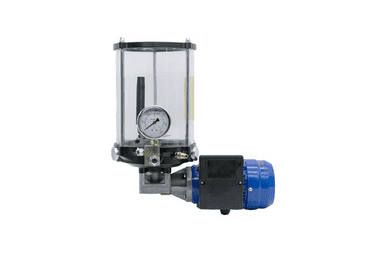
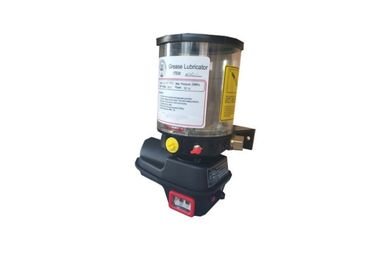
- Pump + controller — CS, CSK, FS, or electric grease station from Related Products.
- Fill filter — 150 μm on grease fill; pair with grease filter in dusty environments.
- Main line — typically Φ8 mm inlet tube (1.5–4.5 m) to the DJF2500 inlet section.
- DJF2500 stack — inlet + 3–10 working slices + end section; cycle monitor on left or right face.
- Branch lines — Φ6 mm outlet tube (1.2–3.5 m) to each bearing, slide, or pin.
One manifold assembly can serve up to 20 points; larger machines may use several stacks fed from one pump header or separate zones.
When to Choose DJF2500 (Not 1000, 2000, or 3000)
- Need 25 MPa with steel body and Viton for elevated ambient or hot machine frames.
- Require the finest twin doses in the DJF family—down to 0.08 ml/cycle on size-5 twin slices (finer minimum than DJF2000 at 0.16 ml).
- Dose per point falls in 0.08–1.28 ml/cycle—below heavy DJF3000 capacity (0.4–4.8 ml/cyc) but above compact DJF1000 pressure class (16 MPa).
- 3–20 outlets on one sequential header with modular slice replacement without full re-piping.
DJF2500 vs Other Metering Architectures
| Architecture | Device | Logic | When to use |
|---|---|---|---|
| DJF2500 progressive (this page) | Sequential steel slices | Series — blocked point stops chain | 25 MPa, 0.08–1.28 ml/cyc, Viton, modular service |
| DJF2000 | Carbon steel progressive | Series | 25 MPa, 0.16–1.12 ml/cyc, carbon steel body |
| DJF3000 | Heavy progressive | Series | 25 MPa, highest ml/cyc per slice |
| SL1 / SL32 PDI | Injectors | Parallel on pressure rise | Per-point adjustable dose; not sequential |
| VSG / ZVB dual-line | Dual-line blocks | Alternating A/B lines | Large mining / steel with reversing valve |
| Lincoln SSV | OEM progressive | Series | Lincoln-compatible replacement builds |
Not dual-line: DJF2500 is single-line progressive only. Do not mount on A/B reversing headers without full system redesign.
Sizing a DJF2500 Stack (5 Steps)
- Point count & dose — list each bearing with ml/cycle from OEM chart or bearing calculator.
- Size code — pick 5–40 and T vs S: twin slices feed two nearby points from one section; single feeds one side only.
- Slice count — sum working slices (≤10) so total outlets ≥ point count; do not plug unused outlets—route or use correct S/T layout.
- Pressure & tube — confirm pump delivers 25 MPa at the farthest Φ6 mm outlet with your NLGI grade; respect max 60 cyc/min with cycle pin installed.
- Monitor — specify mechanical pin or electromechanical switch (250 VAC 1 A or 125 VAC 3 A) for PLC fault stop when pin motion stops.
Ordering Code Example
Example stack: DJF-2500 · 4 sections · indicator 8R (micro-switch, right face) · sequence such as 35T, 15SR, 10T with cross-port CF notation left/right per factory drawing (Section 2 sketch). Cross-port kit P/N 32265-3 (2500 series). Send machine layout for confirmed BOM.
Installation & Commissioning
- Mount with slice T/S markings visible; torque inlet/outlet fittings to spec—never block unused outlets.
- After first fill, bleed air at the highest outlet in the stack; verify one full pin stroke per pump cycle.
- Route tube through lubrication pipe and compression fittings; protect exposed runs near heat or impact zones.
- Log size codes and P/N (22500-xxT/S) in CMMS—when a slice is replaced, match original sequence exactly.
Troubleshooting Quick Reference
| Symptom | Likely cause | Action |
|---|---|---|
| Pin never moves | Blocked outlet, air lock, pump below pressure class | Clear line, bleed air, verify pump at 25 MPa capability |
| Pin moves partially | One slice stuck, wrong NLGI for temperature | Isolate slices; confirm grease pumpability |
| Overpressure alarm | Plugged outlet or blocked progressive chain | Find blocked bearing—never plug ports |
| Uneven delivery | Mixed size codes after field repair | Restore original slice sequence per BOM |
| Seal weeping at slice | Worn Viton O-ring or overtightened fitting | Replace slice seals; torque to spec |
Hub pages: progressive manifold · grease distributor block · metering unit · commissioning service.
Before you buy: read our guide to how distributor blocks work.
Steel with zinc plating. Internal seals are Viton for elevated temperature compared with standard NBR in light-duty aluminum blocks.
25 MPa rated working pressure for oil ≥ ISO VG 68 and grease NLGI #000–#2 within -20°C to +60°C. Size system tubing, pump, and fittings to the same class—not 40 MPa.
Viton O-rings—suitable for higher temperature progressive circuits when paired with correct grease grade and fill filtration.
3–10 working slices per assembly; up to 20 lubrication points per group depending on twin (T) vs single (S) outlet layout.
0.08–1.28 ml/cycle by size code 5–40. Twin size 5 delivers the minimum 0.08 ml/cyc; single size 40 delivers up to 1.28 ml/cyc.
No. Plugging outlets prevents progressive operation and can overpressurize the stack. Use correct S/T slice layout or route unused ports per engineering drawing.
Manual, CS, CSK, and FS grease pumps on Related Products—size pump flow to slice count and cycle frequency (max 60 cyc/min with cycle pin).