What the GGQ Series Does
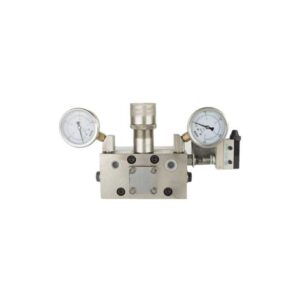
The GGQ series is a family of high-pressure inline filter housings for centralized lubrication systems, installed in the supply line so that lubricant reaches the points downstream after passing the element. This page covers media-element fine filtration. For cleanable coarse mesh protection, see the Y-type strainer filter, which handles a different job. The GGQ housing is built for grease and dry oil circuits, with a stainless steel 316L body and a glass fiber element. The element performs the fine separation inside the housing, and an integrated bypass opens at a stated differential to keep lubricant moving when the element loads up.
Declared Specifications
| Max working pressure | 40 MPa |
| Element rating | 10 micron absolute, 25 micron nominal |
| Max media temperature | 235°C |
| Housing material | stainless steel 316L |
| Element media | glass fiber |
| Bypass valve opens at | 0.5 MPa differential |
| GGQ-P8 | 50 L/min; dirt-holding capacity 150-200 g |
| GGQ-P10 | 80 L/min; dirt-holding capacity 200-250 g |
| GGQ-P15 | 120 L/min; dirt-holding capacity 300-350 g |
How the Filter Works
Lubricant enters the 316L housing and passes through the glass fiber element, which traps particles while the clean stream continues to the outlet. The element rating is stated two ways: an absolute rating is a hard cutoff claim at the stated size, while a nominal rating is an average-efficiency convention. The two are not directly comparable, so a 10 micron absolute element and a 25 micron nominal element should not be read as a simple ratio. As the element collects debris, differential pressure across it rises. At 0.5 MPa differential the integrated bypass opens and lets lubricant continue to the points downstream rather than starving them. A bypass event does not clean anything; it signals that the element is loaded and needs service, and a rising differential trend on a gauge gives the same message earlier.
Choosing a Model and Rating
Size the housing by the line flow the circuit actually delivers. The GGQ-P8 passes 50 L/min, the GGQ-P10 passes 80 L/min, and the GGQ-P15 passes 120 L/min, with dirt-holding capacity increasing across the three. Choose the 10 micron absolute element where fine protection is specified for the points downstream. Choose the 25 micron nominal element for general circuits where that basis matches the specification being followed. Where the real need is coarse debris protection rather than fine filtration, a strainer is the right product instead of a finer element in this housing. Replacement media is ordered through the lubrication filter cartridge set listing; for model and element selection, contact us for a quote.
Installation and Service
Mount the housing in the line with the flow arrow matching the direction of lubricant travel, and confirm the port arrangement against the drawing for the model chosen. Service is driven by the differential pressure trend rather than a fixed interval: record the reading when the element is fresh, then watch how it climbs under normal duty. Replace the element when differential pressure rises toward the bypass setting or when bypass events appear during operation. After any element change, inspect the housing and check for weeping at the joints before returning the line to service. The wider range of filtration components for lubrication circuits is listed on the lubrication filters category page.
What Is Supplied
One filter housing with the element installed. Confirm the model, the element rating, and the port details when ordering, since the three housings differ in flow and the connections follow the model drawing.
Frequently Asked Questions
Is 40 MPa the working pressure or a burst rating?
It is the maximum working pressure. Proof or burst values are not separately declared, so confirm when ordering.
Can it be used with grease and oil?
Both. It is declared for grease and dry oil circuits in centralized systems.
What is the difference between 10 and 25 micron?
The 10 micron figure is absolute and the 25 micron is nominal. They rest on different bases and are not directly comparable.
When does the bypass open?
At 0.5 MPa differential across the element. Sustained opening means the element needs service.
What are the port connections?
They follow the model. Confirm against the drawing when ordering.
How do I choose between the three models?
Choose by line flow: 50, 80, or 120 L/min across the three housings.
Where do I get replacement elements?
Order through the cartridge set listing, matching the rating in use.
What is the maximum temperature?
The declared maximum media temperature is 235°C.
What are housing and element made of?
The housing is stainless steel 316L and the element media is glass fiber.
How do I get specifications and a quotation?
IsoHiTech Lubrication Systems, founded in 2023, engineering since 2006, builds and supports every unit. Email inquiry@isohitech.com for specifications and a quotation.
Contact us for a quote with your line flow, element rating, and connection details.