





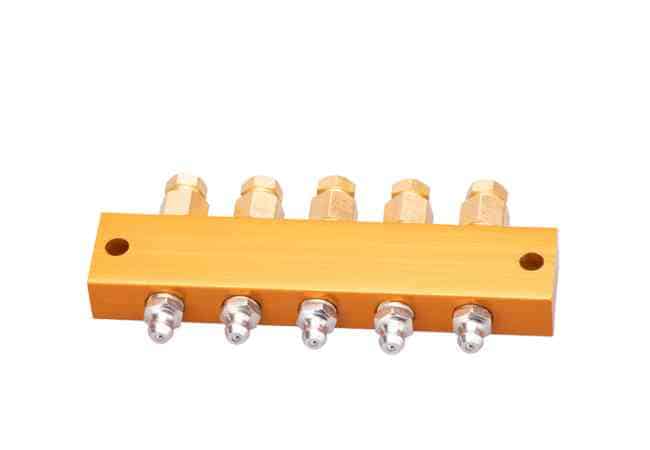

Single-Line Manifold Distributor
Single-line manifold distributors are key to centralized lubrication systems. They deliver precise amounts of lubricants, such as oil and grease, to various points. These systems aim to improve the efficiency and reliability of lubrication in industry.
- Material: Die casting, Aluminum with anodizing manifold distributor
- 2 outlets-12 outlets
- M8,M10,R 1/8 Grease nipple
- Manifold Distributor Video
- Grease Blocks Video
- Adjustable manifold distributor

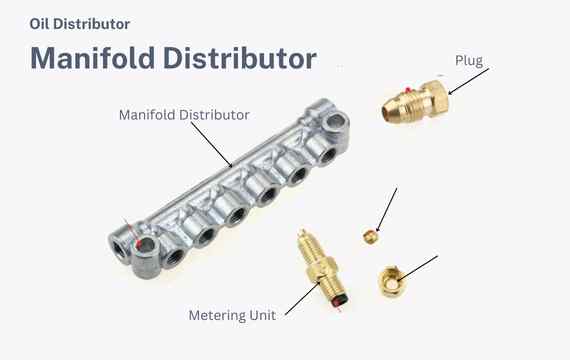
Manifold Distributor
| P.N. | Outlet |
| 30050-2 | 2 |
| 30050-3 | 3 |
| 30050-4 | 4 |
| 30050-5 | 5 |
| 30050-6 | 6 |
| 30050-7 | 7 |
| 30050-8 | 8 |
| 30050-9 | 9 |
| 30050-10 | 10 |
| 30050-11 | 11 |
| 30050-12 | 12 |
The thread could be chosen at M8 or M10.


Oil Adjustable Distributor
| P.N. | Outlet |
| 50050-2 | 2 |
| 50050-3 | 3 |
| 50050-4 | 4 |
| 50050-5 | 5 |
| 50050-6 | 6 |
| 50050-7 | 7 |
| 50050-8 | 8 |
| 50050-9 | 9 |
| 50050-10 | 10 |
| 50050-11 | 11 |
| 50050-12 | 12 |
Single-Line Manifold Distributors in Lubrication
Single-line manifold distributors are key to modern lubrication systems. They deliver lubricants efficiently, reliably, and precisely. They can work independently and adjust their output. So, they are ideal for many industrial uses. They improve maintenance and machine performance.
Functionality of Single-Line Manifold Distributors
Single-line distributors use a central pump that pressurizes a main supply line. This line feeds multiple injectors or piston distributors. Each lubricates a specific point. The key features include:
- Independent Operation: Each injector can work alone. This allows precise control over the lubricant delivered to each lubrication point. This design lowers the risk of system failure. If one injector fails, the others work normally.
- Adjustable Output: The injectors can be adjusted to dispense different amounts of lubricant. This meets the varying lubrication needs of different machines.
- Pressure Management: The system operates at 10 to 45 bar. This ensures the effective delivery of lubricants over long distances.
Types of Single-Line Systems
There are primarily two configurations of single-line lubrication systems:
- Single-Line Parallel Systems:
- These are the simplest forms of automatic lubrication systems.
- They allow multiple injectors to be fed from a single supply line. Each injector serves one lubrication point independently.
- This setup is easy to install and modify. So, it’s suitable for various industrial applications.
- Series Progressive Systems:
- In this configuration, lubricant flows sequentially through a series of metering valves.
- Each valve is set to deliver a specific amount of lubricant to its point.
- This system needs more complex engineering. But it allows precise control over lubricant distribution.
Applications and Benefits
Single-line manifold distributors are used in many industries. These include manufacturing, automotive, and heavy machinery. Their benefits include:
- Reduced Maintenance Costs: These systems automate lubrication. They cut costs linked to manual methods.
- Increased Equipment Lifespan: Proper, consistent lubrication prevents machinery wear and tear. It extends its operational life.
- Enhanced Safety: Automated systems reduce the risks of manual lubrication tasks. These tasks can be hazardous in some environments.
Related lubrication resources
Single-line lubrication · Automatic lubrication · Injection lubrication
Before you buy: read our guide to how distributor blocks work.
A single-line manifold is part of a lubrication system. It distributes lubricant from a main supply line to multiple points. It allows for efficient, controlled delivery of lubricant to machinery.
In a single-line system, a pump pressurizes the main supply line. The manifold has many outlets. They distribute the lubricant to individual points. The lubricant flows through the manifold. Each outlet can have an injector or metering device. It controls the amount of lubricant delivered.
- Simplicity: The design is straightforward, making it easy to install and maintain.
- Cost-effective: a lower initial investment compared to more complex systems.
- Independent Operation: Each injector works on its own. If one fails, the others are unaffected.
- Monitoring Challenges: Without extra sensors, detecting blockages or failures at individual lubrication points is hard.
- Lubricant Starvation Risk: A blockage in one line may stop lubricant flow to the affected point. This could cause equipment failure.
Single-line manifolds can use various lubricants, including oils and greases. This depends on their design and material compatibility.
Consider factors such as:
- The number of lubrication points
- Operating pressure and temperature ranges.
- Type of lubricant used.
- Material construction for corrosion resistance.
- Size and configuration of ports.
You can usually expand single-line manifolds by adding or adjusting injectors. The pump must handle the extra volume.
Regular inspections are needed to check for blockages, wear, and injector operation. Lubricant levels and system pressure should also be monitored periodically.