Selecting a pneumatic grease pump is a sequence of decisions: container, pressure ratio, NLGI grade, air supply, and mounting. This guide walks through them in order.
What a Pneumatic Grease Pump Does
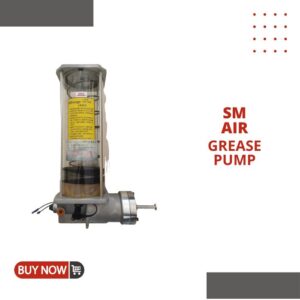
An air motor drives a reciprocating piston; the ratio between the air and grease piston areas multiplies air pressure into much higher grease pressure at the outlet. These pumps need no electrical power nearby and stall against a closed gun without damage.
Step 1: Match the Container
The container sets pump tube length and follower plate diameter. Common formats are the 5 gallon / 20 kg pail, the 120 lb / 54 kg keg, and the 400 lb / 181 kg drum. The plate must match the container’s inside diameter to wipe the wall and hold the prime, and the tube must reach the bottom.
For pails, see the 25 kg pneumatic grease pump. For kegs, the grease keg pump covers the 120 lb format. For drums, start with the 55 gallon drum grease pump.
Step 2: Pick the Pressure Ratio
The ratio tells you how hard the pump pushes. A 50:1 pump on 100 PSI air delivers roughly 5,000 PSI of grease pressure; a 100:1 pump on the same supply reaches roughly 10,000 PSI. Higher ratios overcome longer lines, smaller fittings, and stiffer grease, in exchange for lower flow.
| Pressure ratio | Output at 100 PSI air supply |
|---|---|
| 50:1 | ~5,000 PSI (345 bar) |
| 60:1 | ~6,000 PSI (414 bar) |
| 100:1 | ~10,000 PSI (689 bar) |
Size for continuous duty, not the peak: continuous working pressure should stay near 80 percent of maximum output. A point close to that 80 percent line leaves no headroom for cold grease or a long line.
Step 3: Check NLGI Grade and Temperature
NLGI grade measures grease stiffness. Soft grades prime easily; hard grades resist priming and demand more ratio, especially in the cold.
| NLGI grade | Consistency | Selection note |
|---|---|---|
| 000 / 00 | Semi-fluid | Any ratio; watch for grease escaping past the plate edge |
| 0 / 1 | Soft to medium | 50:1 handles most hose lengths |
| 2 | Standard bearing grease | 50:1 for short runs; 60:1 for longer lines or cold rooms |
| 3 | Stiff | 60:1 or higher; confirm performance below 10°C first |
Match seals to grease chemistry: NBR suits mineral-oil greases; FKM is the choice for polyurea, PAO, and ester-based products.
Air Supply Requirements
The air system decides whether the pump reaches its published numbers. An undersized compressor or a long small-bore line starves the motor and slows cycling.
| Parameter | Requirement |
|---|---|
| Supply pressure | 80-120 PSI (5.5-8.3 bar) |
| Air consumption | 3-8 CFM while cycling |
| Air inlet | 1/4″ NPT or 3/8″ NPT |
| Air line | Runs over 5 m need 3/8″ ID or larger |
| Air treatment | 5-micron filter-regulator plus lubricator at 1-2 drops/min of 32 cSt oil |
Mounting and Installation
Drum-cover mounting drops the tube through the cover; wall mounting draws through a separate suction hose; trolley mounting makes the unit portable between containers. At first start, prime at 40-60 PSI until grease flows steadily, then raise to working pressure. The outlet is 1/4″ NPT female; every hose and fitting downstream must be rated to cover the pump’s maximum output.
Troubleshooting Quick Reference
| Symptom | Likely cause | Fix |
|---|---|---|
| Pump cycles but no grease | Air pocket under the follower plate | Re-prime at 40-60 PSI and reseat the plate |
| Slow cycle rate | Starved air supply or a long small-ID line | Check supply pressure; upgrade the line to 3/8″ ID |
| Grease at the air exhaust | Worn pump tube seals | Service the tube assembly |
| Stalls against a closed gun | Ratio too low for the NLGI grade or line length | Move to a higher ratio pump |
Pneumatic vs Electric vs Manual
Where compressed air already exists and daily grease volume is high, pneumatic wins on continuous duty and simplicity. An electric grease pump suits fixed stations without air lines; a hand grease pump covers low-volume service work. Many plants run all three, matched to each station.
What Is Supplied
A complete unit includes the air motor, pump tube assembly, container-matched follower plate, drum cover or wall bracket as ordered, and the outlet connection. Confirm container size, grease grade, and hose length when you request a quotation.
Frequently Asked Questions
What does a 50:1 pressure ratio actually mean?
It compares air piston area to grease piston area. Multiply air pressure by the ratio: 100 PSI into a 50:1 pump gives about 5,000 PSI of grease pressure.
What compressor size does a pneumatic grease pump need?
Plan for 3-8 CFM at 80-120 PSI while the pump cycles. A shop compressor with a receiver tank covers intermittent greasing; continuous use needs more headroom.
What is the real difference between a 50:1 and a 100:1 pump?
Pressure and flow trade off. The 100:1 pump doubles available pressure for long lines and stiff grease; on the same air supply, the trade-off is lower flow.
What should I do for grease stiffer than NLGI 2?
NLGI 3 calls for a 60:1 ratio or higher, a generous hose ID, and a cold check: confirm priming below 10°C with your grease before standardizing.
How do I match pump tube length and follower plate to my container?
Measure container height and inside diameter. The tube must reach near the bottom, and the plate must match the bore to wipe the walls.
What do the flow numbers assume?
Published flow figures are free-flow maximums taken with no outlet restriction. As back pressure rises toward stall, flow falls toward zero.
How does air consumption relate to duty cycle?
The 3-8 CFM figure applies while the pump strokes. A gun used in short bursts averages far less than a pump feeding an open line.
Any cold-weather startup notes?
Cold grease stiffens and resists priming. Start at 40-60 PSI until flow stabilizes, keep the filter drained, and hold the lubricator at 1-2 drops per minute.
Which pump fits a pail, keg, or drum?
Each format has a matched configuration with the right tube length and follower plate; the container section above links the pail, keg, and drum options.
How do I get a sizing confirmation and a quote?
IsoHiTech Lubrication Systems, founded in 2023, engineering since 2006, confirms ratio, tube, and follower plate for your container and grease. Send container size and NLGI grade to inquiry@isohitech.com or use the quote request page.