


Grease Hose Fittings
Grease hose fittings are the parts at the hose end: straight and 90° hose studs that thread into divider outlets and clamp the hose with a compression sleeve, barbs and Quicklinc studs for 6 mm KF300 hose, threaded swivels for NPT lines, and the couplers that join two lengths. The pump makes the pressure; the hose end decides whether it stays inside.
The catalog is organized by the hose it terminates: 8.6×4 mm and 11×6 mm polyamide hose with stud-and-sleeve assemblies rated 350 bar, and 6 mm KF300 / Quicklub hose with barbs and push-in studs. Lincoln part numbers — the 223-, 432-, 532- and 272-series — sit directly in the page titles, so a maintenance sheet resolves to a part without measuring anything.
Hose runs also need anchors: greasing blocks, remote anchor blocks and SSV divider fittings that give a hose run somewhere to terminate. Many of these parts are also cataloged on the line fittings page, which follows joints along the run, and the pump fittings page, which covers the outlet side — this page follows the hose itself.
Hose System Quick Match
| Your hose | End fitting | Notes |
|---|---|---|
| 8.6×4 mm polyamide | Straight or 90° stud + 8.6×4 sleeve | 350 bar; sleeve is single-use |
| 11×6 mm polyamide | Stud + 11×6 threaded sleeve | Larger-bore central systems |
| 6 mm KF300 / Quicklub | Quicklinc stud or barb, push-in | Lincoln Quicklub hose standard |
| NPT threaded line | Swivel male, screw-in adapter | 1/8″ and 1/4″ NPT common |
Cataloged Hose Fittings
| Catalog page | Covers |
|---|---|
| Straight hose stud, 8.6×4 | Carbon steel, 350 bar working pressure |
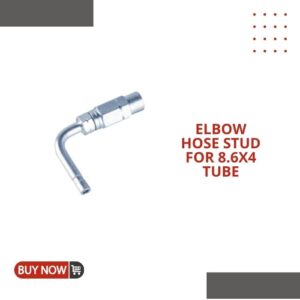
| 90° elbow hose stud, 8.6×4 | Corner routing without bending the hose |
| Compression sleeve, 8.6×4 | The clamping half of the stud pair |
| Compression sleeve, 11×6 | For 11 mm OD polyamide hose |
| Lincoln 272401 straight stud | Quicklub straight hose stud |
| Lincoln 272394 elbow assembly | 90° Quicklub stud with nut |
| Lincoln 432-24162-1 stud | Short straight 6 mm Quicklinc stud |
| Lincoln 432-30739-1 barb | 6 mm KF300 hose barb |
| Lincoln 532-30739-1 90° stud | Short 90° for KF300 hose |
| Fritsche #100-054-NUT stud | 6 mm stud for European systems |
| Lincoln 223-10080-5 screw-in | 10 mm to 1/4 NPT conversion |
| Straight 1/8″ NPT swivel | Swivel for tight NPT ports |
| LUBE #403001 hose coupler | Joins two high-pressure hose lengths |
| High-pressure hose assembly | Hose supplied with fittings fitted |
| Lincoln 226-14091-4 valve body | Push-in stud with groove + check valve |
| Lincoln 504-30344-4 outlet valve | M10×1 outlet with 6 mm tube seat |
| Lincoln SSV divider fittings | Outlets and plugs for SSV dividers |
| Lincoln 303-17499-3 closure plug | Seals unused SSV/SSVD outlets |
| Greasing block | Steel multi-point distributor block |
| Remote grease anchor block | Anchors remote hose runs |
| Remote line, reusable fittings | Pre-built line with field-reworkable ends |
| Remote line, 6 mm nylon | Tube version with compression ends |
Parts shared with neighboring pages: check valves, compression fittings and push-in connectors are also cataloged under grease line fittings; outlet-side adapters and tees under grease pump fittings; the point-end nipples under grease nipples; and manifold hardware under lubrication manifolds.
Grease Hose Fitting FAQ
How do I re-terminate a damaged hose end?
Cut the hose square behind the damaged section, discard the old sleeve, and assemble a new stud with a new sleeve — the stud is reusable, the sleeve is not. The seal is made by the sleeve biting into the hose wall as the stud tightens, so a sleeve that has already crushed one hose will not grip a second one properly. That single-use rule is the most common field mistake; stock sleeves alongside studs.
KF300 and 8.6×4 — are they the same hose system?
No. KF300 is the Lincoln hose family used with 6 mm fittings — Quicklinc studs, barbs and push-in connectors. The 8.6×4 mm polyamide hose is a different size with its own studs and sleeves, joined by threaded sleeve assemblies rather than barbs. Measure the outside diameter and the bore before ordering: 8.6 mm OD takes the 8.6×4 system, 6 mm takes the KF300 family, and nothing interchanges between them.
Stud-and-sleeve, barb, or push-in — which holds up on vibrating machinery?
The stud-and-sleeve clamp is the one to trust at 350 bar and continuous vibration, because retention comes from metal crushed onto hose, not a spring collet. Push-in Quicklinc connectors win on assembly speed and clean rework when points move occasionally. Barbs with clamps suit low-pressure retrofit work. Fixed central systems on vibrating machinery get studs; production lines with layout changes get push-in.
What does a remote greasing run need besides hose?
An anchor point and a terminator: a greasing block or remote anchor block bolted near the cluster of points, remote line assemblies routed to each point, and stud or push-in ends making the joints. The assemblies are cataloged above pre-built with reusable or compression ends, and the block side is detailed on the lubrication manifolds page.
I have a Lincoln part number from the manual — can you match it?
The numbered pages carry the part numbers in their titles — 223-, 226-, 303-, 432-, 504-, 532- and 272-series on this page and the line fittings page. If a number is not on the shelf list, send it through the contact page with the machine and hose size, and cross-references to equivalents come back in one reply.



- Sale!

- Sale!

- Sale!


- Sale!

- Sale!

- Sale!

- Sale!
