


Grease Line Fittings
Grease line fittings are the joints along the run from pump to bearing: hose studs that thread into manifolds and divider outlets and clamp the hose with a compression sleeve; 24° cone compression fittings for nylon tube; Quicklinc push-in connectors for fast assembly; and check valves that hold line pressure between cycles. The pump makes the pressure — these parts decide whether it arrives.
IsoHiTech catalogs them by the line they serve: 6 mm nylon tube systems, and 8.6×4 mm and 11×6 mm polyamide hose systems, with Lincoln KF300 / Quicklub part numbers cross-referenced page by page — the 223-, 226-, 432-, 504-, 532- and 272-series units each carry their number in the title so a maintenance sheet resolves directly to a part.
These parts sit in a family of related categories: hose end and pump-outlet fittings are cataloged separately as hose fittings and pump fittings, and many parts appear in several lists. This page follows the flow path along the line itself; remote greasing lines and anchor blocks live under lubrication manifolds, and the hose assemblies under pressure hoses.
Choosing by Connection Method
| Method | Typical use | Rework |
|---|---|---|
| Threaded hose stud + sleeve | 8.6×4 and 11×6 polyamide hose, 350 bar | Sleeve is one-time; stud reusable |
| Compression, 24° cone | 6 mm nylon tube, DIN 2353 practice | Reusable with new ferrule |
| Push-in Quicklinc | Fast assembly and point changes | Reusable; check collet wear |
| Barbed hose tail | Low-pressure retrofit work | Hose clamp; single use |
Cataloged Parts
| Catalog page | Covers |
|---|---|
| Straight hose stud, 8.6×4 | Carbon steel zinc-plated, 350 bar |
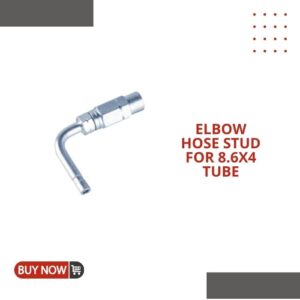
| 90° elbow hose stud, 8.6×4 | Corner routing without a bent hose |
| Compression sleeve, 8.6×4 | The clamping sleeve for 8.6 mm hose |
| Compression sleeve, 11×6 | Sleeve for 11 mm OD polyamide |
| Lincoln 272401 straight stud | Quicklub straight hose stud |
| Lincoln 272394 90° elbow | Quicklub elbow stud assembly |
| Lincoln 432-24162-1 stud | Short straight 6 mm Quicklinc stud |
| Lincoln 532-30739-1 90° stud | Short 90°, KF300 hose |
| Fritsche #100-054-NUT stud | 6 mm hose stud, European systems |
| Lincoln 226-14091-2 check valve | Non-return for SSV systems |
| Lincoln 504-30344-4 check valve | M10×1 outlet valve, 6 mm tube |
| SKF non-return valve | Brand-equivalent check valve |
| Compression straight fitting | DIN 2353 / ISO 8434-1, 24° cone; also under compression fittings |
| Quicklinc nylon push-in | Push-in connectors for nylon tube |
| Push-in tube union | Tube-to-tube quick splice |
| Push-in swivel elbow | Male-thread swivel for tight corners |
| Adapters & straight extensions | Thread and reach conversion |
| WE6-LL M10×1K elbow | Bijur-format elbow connector |
Long straight nipples for direct point connections are cataloged on the grease nipples page; remote line assemblies and anchor blocks on the lubrication manifolds page.
Grease Line Fittings vs. Zerk Grease Fittings
A zerk grease fitting is the terminal coupler at the bearing; grease line fittings are the joints along the tube and hose that carry grease from the pump to that fitting. On runs longer than a few meters, or wherever one pump feeds several points, the hose studs, compression sleeves and check valves in this category keep the line pressure-tight between cycles. For the terminal couplers themselves — thread forms, button-head and flush variants, size charts — see the grease fitting types guide and the grease zerk size chart.
Grease Line Fitting FAQ
8.6×4 hose or 6 mm tube — which system am I servicing?
Measure the line: 8.6 mm outside diameter with 4 mm bore is the polyamide hose standard behind Lincoln KF300 and Quicklub installations; 6 mm solid-wall nylon tube with 24° cone compression ends is the newer practice. The two use different studs, sleeves and tools, and nothing interchanges — one caliper reading before ordering saves a return.
How does a hose stud and sleeve actually seal?
The sleeve is a compression ring: tightening the stud drives its cone into the sleeve, which bites into the hose wall and clamps it against the stud body. The seal is the crushed hose itself, which is why a sleeve is a single-use part — reusing one on a new hose is the most common cause of blow-off at pressure. Stock sleeves with the studs; they are the consumable half of the pair.
Why put a check valve at the divider outlet?
Between cycles, an open outlet lets grease relax back toward the divider — on long or vertical runs the line drains, and the next cycle spends its first seconds refilling instead of feeding. The outlet check valve holds line pressure so every cycle delivers at the point. On SSV and SSVD progressive systems the outlet valves also let individual points be serviced without draining the main.
Push-in or threaded — which do I trust?
Both hold rated pressure when new and correctly assembled. Push-in wins on assembly speed and clean rework — press in, release, done. Threaded stud-and-sleeve wins on continuous vibration, heat, and 350 bar service, because the clamp on the hose does not depend on a plastic collet. Production lines with occasional point moves suit push-in; fixed central systems on vibrating machinery suit threaded.
I only have a Lincoln part number from the manual — can you match it?
That is what the numbered pages are for: the 223-, 226-, 432-, 504-, 532- and 272-series titles carry the part numbers directly, so the maintenance sheet resolves to a page without measuring anything. If a number is not on the shelf list, send it through the contact page with the machine and line size — cross-references to equivalents come back in one reply.



- Sale!

- Sale!

- Sale!

- Sale!

- Sale!

- Sale!


- Sale!
