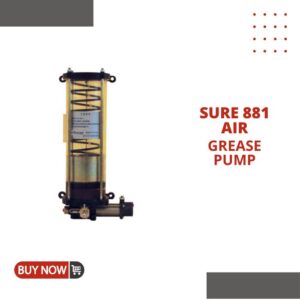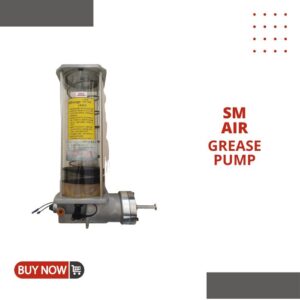


A pneumatic grease pump turns ordinary shop air into high-pressure grease flow. This one is built around 25 kg pails — the bulk container most workshops and fleets actually handle — and turns it into a permanent greasing station.
Maintenance sheets also list this unit under air grease pump and air-operated grease pump – compressed-air driven, same pump.
What This Pump Is
This is a pail-mounted pneumatic grease pump. It sits on a 25 kg pail, seals against the grease with a follower plate, and runs on shop air. You keep the pail on the floor and pull grease straight from the container into a hose and a gun, so there is no transfer step and no drum handling. It suits a workshop where grease arrives in 25 kg lots and the draw point is a bench, a bay, or one machine. For heavier duty cycles, work through the duty class guide for heavy duty grease pumps first.
Declared Specifications
These are the declared values for this configuration. Treat them as a working envelope rather than one fixed operating point, and match them against your gun, hose, and air supply.
| Pressure ratio | 50:1 |
| Air inlet | 4 to 10 bar, 7 to 8 bar recommended |
| Maximum output | 400 to 425 bar, 400 bar continuous |
| Output flow | 300 to 400 g/min, about 350 g/min at 8 bar |
| Air consumption | 80 to 120 L/min |
| Container | 25 kg pail, inner diameter 300 to 350 mm, follower plate fitted |
| Grease grades | NLGI #000 to #2 |
Reading the 50:1 Ratio
The ratio multiplies the air pressure you feed the pump. At 8 bar the ceiling is 400 bar; at 7 bar the ceiling is lower in step. That figure is a ceiling, not a promise. Line resistance, hose bore, grease stiffness, and the gun all take pressure away before the grease arrives, so delivery falls as resistance rises. A unit rated at 400 bar continuous can still move grease slowly through a long, narrow hose. Design around the 400 bar continuous figure and treat 425 bar as the peak it can reach.
Why Shops Choose a Pneumatic Grease Pump
Compressed air does the work: an air motor drives a piston pump, and discharge pressure follows the pump’s ratio multiplied by inlet air pressure. No electric motor at the pump means no electrical spark source there — a practical characteristic of air-operated equipment in workshop environments. Three reasons shops land on this pump class:
- Continuous duty. A pump fed from a bulk pail greases route after route without cartridge changes — it is designed to transfer grease from bulk containers to guns and lubrication points.
- Pressure on demand. Ratios in this class multiply modest shop air into the thousands of psi at the grease side, enough for couplers, short lines, and stubborn fittings.
- One grease, many guns. Mounted on the pail lid with a follower plate below, it fills guns through a filler hose and keeps the whole shop on one bulk grease.
For the physics — air motor, cycling, stall pressure — see the companion how a pneumatic grease pump works technical guide.
Choosing the Container Size
The follower plate has to match the pail, not the other way around. This plate covers pails with an inner diameter of 300 to 350 mm, so measure yours across the top lip before you order. A dented pail, a tapered pail, or a seam that stands into the plate path breaks the seal, and grease climbs the wall instead of the tube. If you move to a drum later, you need a different pump tube and plate; this unit does not convert. When you also move grease in bulk, cover that job with a low pressure bulk transfer pump and keep this one at the point of use.
Air Supply Requirements
Your compressor has to hold the consumption figure for as long as the pump runs, not just reach it once. A pump drawing 80 to 120 L/min will starve on a small tank and a tired regulator, and a starved pump strokes slowly. Fit a regulator so you can hold the inlet between 7 and 8 bar, and fit a water trap ahead of the pump. Drain that trap regularly, because a wet air motor carries grit into the bore. If you are unsure your compressor holds the figure, send the tank size and cut-in pressure through our quote request page.
Outlets, Hose, and Gun Setup
Hose length and gun type set the flow you actually get, often more than the pump does. A long, narrow hose on cold grease eats pressure faster than the pump can rebuild it, so keep the hose as short as the job allows. A lever gun on a short whip responds best at the fitting; a long reel run does not. In cold weather, bring the pail indoors the night before. If the pump has to run on a timer or a level switch instead of a hand valve, start from the controller selection for automatic lubrication pumps page.
How Much Grease Per Lubrication Point?
The most-asked question on any greasing route is simply how many pumps per fitting. The honest answer has two parts. First, if the equipment manual publishes stroke counts per point, use those numbers — they reflect the actual bearing sizes on that machine. Second, where no manual figure exists, calibrate instead of guessing: weigh your grease gun on a kitchen scale, pump ten strokes into a cup, and divide. Gun output varies from tool to tool, so a calibrated per-stroke weight plus the bearing’s required quantity beats any universal rule of thumb.
One figure that is worth knowing when you calculate quantities: SKF’s guidance is to fill only 30–50% of the free space in a bearing housing. A cavity packed 100% full churns, heats, and pushes grease past the seals — over-greasing damages anti-friction bearings faster than a modest shortage. If you service dozens of points per shift and currently work from cartridge guns, a pail-fed setup such as this machine or an electric pail pump gives you measured output at arm-saving speed; for occasional points a manual grease gun remains the right tool.
Frequently Asked Questions
Which pump size fits my workshop?
Size the pump to your daily grease volume, not to your pail size. A pail-mounted unit suits one or two guns used through a shift.
Pail pump or drum pump?
Choose the pail unit when grease arrives in 25 kg lots and you draw it close to where it is used. Choose a drum unit when one container must feed high volume across a bay.
What compressor does it need?
It needs air that holds 80 to 120 L/min at your working pressure without dropping. A small compressor with a tiny tank will run out of air and stall the pump mid-stroke.
What grease grades can it pump?
It handles NLGI #000 to #2. Thicker grease moves slower and pulls more pressure, so expect lower output as you move up the scale.
Is a follower plate included?
Yes, the kit includes a follower plate sized for pails between 300 and 350 mm inner diameter. A plate from another pail size will not seal.
What if my pail is dented or nonstandard?
A dent or a taper stops the plate from wiping the wall, and grease then climbs past the seal. Straighten the pail or move the grease into a sound container that measures within the range.
Will it start with cold NLGI #2 grease?
It will start, but the first strokes will be slow and the outlet pressure will sit high. Warm the pail indoors overnight, or use a lighter grade for cold starts.
How do I know when the pail is nearly empty?
Flow drops and the follower plate sits low in the pail. Watch the plate and the gun response, and change pails before the pump runs dry.
What should I state when ordering?
State the pail inner diameter, the grease grade, and the air pressure you can hold at the pump. Send those figures through the quote request page so the configuration is checked before it is built.
How do I get specifications and a quotation?
IsoHiTech Lubrication Systems, founded in 2023, engineering since 2006, builds and supports every unit. Email inquiry@isohitech.com for specifications and a quotation.
Do I need a follower plate for a 25 kg pail?
It is strongly recommended. Follower plates are offered specifically sized for 25 kg pails and smaller buckets, not only 55-gallon drums. The plate rides on the grease surface, wipes the pail wall, and feeds the pump inlet — without it you lose prime as the pail empties and strand grease on the walls.
Can this pneumatic grease pump fill grease guns?
Yes. Filling guns from a bulk pail is the core job of this pump class: mount it on the pail, connect a filler hose with coupler, and load guns in seconds instead of scooping grease or buying cartridges.