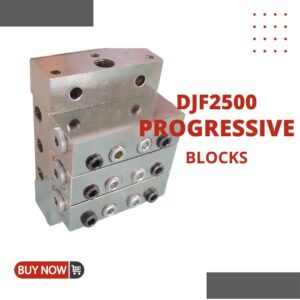
Overview
An adjustable lube oil grease distributor valve splits one supply line into several metered outputs, each tuned to the point it feeds. Instead of delivering the same shot of lubricant to every bearing, each outlet is set independently, so a large slow bearing and a small fast one can receive different volumes from the same assembly. The valve handles oil of various viscosities and grease up to NLGI Grade 2, covering most centralized lubrication designs.
The standard body is brass, with aluminium and high-strength plastic options. Outlet counts run 2, 4, 7, 10 or 12, with assemblies up to 22 outlets. Adjacent outlets can be combined where one point needs more than a single outlet delivers.
Declared Specifications
| Parameter | Specification |
|---|---|
| Number of outlets | 2, 4, 7, 10, 12, up to 22 outlets |
| Flow per outlet | 0.2 ml per cycle (standard), adjustable up to 0.6 ml |
| Flow combination | Adjacent outlets can be bridged for higher volume |
| Body material | Brass (standard), aluminium or high-strength plastic |
| Operating pressure | Up to 100 bar (system dependent) |
| Pump compatibility | Most standard lubrication pumps, from at least 5 bar |
| Thread options | M8, M10, R 1/8 |
| Valve types | Progressive (sequential) or block/slice (independent) |
| Lubricant | Oil of various viscosities, or grease up to NLGI Grade 2 |
| Adjustment | Manual screws/knobs or solenoid-controlled |
| Monitoring | Optional visual indicators or electronic sensors |
| Temperature range | -10°C to 70°C |
Progressive or Block Type: Choosing the Right Valve
Progressive (sequential) valves feed the outlets in a fixed order, one after another. A blockage anywhere in the string stops the whole divider, and one indicator pin on the valve flags the fault, so progressive valves are easy to monitor with minimal hardware.
Block/slice (independent) valves feed every outlet at the same time, each from its own piston. Adjustment is more flexible and one blocked line does not stop the rest, but a blockage does not announce itself either, so critical points need their own monitoring. Visual indicators or electronic sensors are optional on both types.
Adjustable outlets suit plants whose lubrication map still changes. Where duty is fixed and volumes are settled, a fixed divider or a dedicated grease manifold block is often the simpler choice. For how divider valves meter lubricant internally, see the guide on how distributor blocks work.
Installation and Setting
The valve connects to the main lubricant line through M8, M10 or R 1/8 threads, and smaller branch lines run from each outlet to its lubrication point. A maintenance technician familiar with the machine can normally complete the installation in a few hours, including running the branch lines.
Start every outlet at the standard 0.2 ml per cycle, then raise toward the 0.6 ml per-outlet maximum only where bearings need it. Settings normally stay set once commissioned; re-adjust only when equipment, lubricant or operating conditions change. Adjustment is by manual screws or knobs; solenoid-controlled versions suit automated lines.
Applications
Typical uses include hard-to-reach wind turbine bearings, mining and construction machinery working in dust, paper mill rolls, assembly lines feeding many points from one pump, textile machinery where excess oil would mark fabric, and industrial robots on programmed lubrication cycles. The common requirement is the same in every case: several points, different volumes, one supply line.
Maintenance
Watch the indicator pins or sensors to confirm the valve is cycling, keep the lubricant clean, and re-check settings after any mechanical change. On progressive valves, a stalled string usually means a blocked branch line; clear the line rather than raising pump pressure. On block-type valves, verify critical outlets individually, because the valve itself will not signal a single blocked line.
For help sizing an assembly to your point count and per-point volumes, request a quote with your lubrication map.
FAQ
What is an adjustable distributor valve?
A metering component that divides one supply line into multiple outlets, each set to a specific volume per cycle. It replaces manual greasing rounds or fixed dividers where different points need different amounts of oil or grease.
What is the difference between progressive and block-type valves?
Progressive valves distribute in sequence, one point after another, so a blockage stops the whole string and is easy to detect. Block/slice valves feed all points independently: more adjustment freedom, but no automatic blockage signal.
How much lubricant does each point receive?
Each outlet delivers 0.2 ml per cycle as standard, adjustable up to 0.6 ml. If a point needs more, adjacent outlets can be combined to increase the volume.
Will the valve work with my existing pump?
Yes, with most standard lubrication pumps delivering at least 5 bar; system pressure should not exceed 100 bar.
How often do the settings need changing?
Normally only at commissioning. Re-adjust when you change equipment, switch lubricant, or see under- or over-lubrication at a point.
How do I know the valve is working?
Visual indicators move as lubricant flows; electronic sensors can report cycles to your control system.
Can it handle grease as well as oil?
Yes. The valve meters oil of various viscosities and grease up to NLGI Grade 2.
How difficult is installation?
The valve threads onto the main line (M8, M10 or R 1/8) and branch lines run to each point; a maintenance technician typically finishes in a few hours.
Should I choose an adjustable valve or a fixed divider?
Choose adjustable where per-point volumes may change; choose fixed where the lubrication map is settled and simplicity matters more.
Who can help me configure an assembly?
IsoHiTech Lubrication Systems, founded in 2023, engineering since 2006, can review your point list and volumes and quote a matched assembly. Write to inquiry@isohitech.com or contact our lubrication engineers directly.