



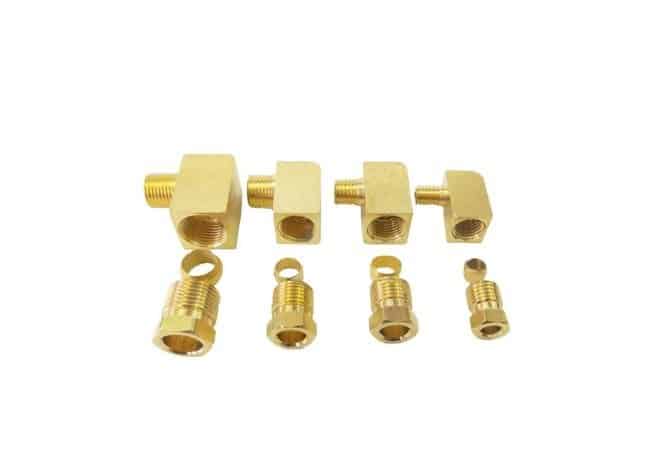


What the Elbow Does
An elbow changes the direction of a lubrication line at the point where it enters a component. This page covers the threaded-connection axis of the elbow family: the port thread on one side, the tube connection on the other. The tool-free style is covered separately on the push-in elbow page.
Two angles are offered, 90 and 45 degrees. The 90 degree body turns the line through a right angle; the 45 degree body makes a gentler change. Both are made in C3604 brass, which machines cleanly and holds a thread form well. Because the body is brass, it should never be forced; the thread is the part that deforms first if a wrench is over-applied.
Every elbow in this range combines one threaded port end with one tube end. The tube end accepts a tube outside diameter of 4, 6 or 8 mm in the compression style.
Declared Specifications
| Material | C3604 brass |
| Body angles | 90 and 45 degrees |
| Maximum working pressure | 30 to 60 bar, which is 3 to 6 MPa, depending on size |
| Thread forms | M6x1, M8, M10, M12, R1/8, R1/4 in BSPT form, NPT, UNF |
| Tube outside diameter | 4, 6 and 8 mm, compression style |
| Fitting body temperature range | 0 to 60 °C |
| System temperature range | -40 to +100 °C |
| Reorientation | Some models rotate after tightening |
| Sealing method | Depends on thread form, tapered or parallel |
| Tube grip | Sleeve grips and seals on the tube outside diameter |
Matching Threads and Tubes
Thread matching begins with the form, not the size. R1/8 and R1/4 are tapered threads of BSPT form. NPT is also tapered, but it is a different taper and must never be mixed with BSPT; the two will bind and damage each other. UNF and metric M threads are parallel forms, so they seal by a different method entirely. Confirm the thread form when ordering.
On the tube side, 4, 6 and 8 mm refer to the tube outside diameter, not to a nominal bore size. The compression style grips and seals on that outside diameter with a sleeve. Related parts in the same family are described on the brass compression sleeve and straight compression fitting pages.
To compare the full lubrication fittings category, or contact the team with the port thread form and the tube outside diameter to hand.
Sealing by Thread Form
Tapered threads seal on the threads themselves. As the male thread is drawn in, the flanks interfere along the taper and close the helical path. A thread sealant or tape applied to tapered threads supports that interference.
Parallel threads behave differently: they need a washer or an O-ring seated against a flat face to make the seal. Tape alone will not seal a parallel thread. The most common field error is tape on a parallel thread; it will not seal. M6x1, M8, M10, M12 and UNF are parallel forms and follow this rule.
Installation Notes
Tighten to a firm seat, then a fraction more. Brass threads and brass bodies deform under excess torque, and a split nut or a stretched thread cannot be recovered.
Leave wrench clearance. An elbow pointing into a neighbouring part may be impossible to tighten later. After the first pressurisation, check for weeping at both the thread and the tube end.
Some models can be reoriented after tightening by backing off slightly. Set the orientation before final tightening wherever the geometry allows. Confirm the thread form when ordering.
Choosing Between Elbow Angles
Choose 90 degrees when the line must turn sharply around an obstacle. Choose 45 degrees when the direction change is gentler and the tube can sweep through the turn without a tight bend at the fitting. A 45 degree body usually reduces the bending stress carried by the tube right at the compression nut.
The pressure rating of 30 to 60 bar is a working-pressure figure. Where a pump pulses the line, count pump pulses inside it. At elevated temperature towards the top of the range, derate the working pressure and confirm the figure with the supplier before the line is put into service.
Frequently Asked Questions
Can R1/8 and NPT 1/8 threads be interchanged?
No. Both are tapered but the taper differs, so they bind and damage each other.
What does a 6 mm tube size refer to?
The tube outside diameter, not a nominal bore size.
When should I choose 45 degrees instead of 90?
Use 45 degrees for gentler direction changes that reduce tube stress at the fitting.
How do tapered threads seal?
The thread flanks interfere along the taper, closing the helical path. Sealant or tape supports that.
How do parallel threads seal?
A washer or O-ring seated against a flat face seals them. Tape alone will not work.
Is the pressure rating static or cyclic?
It is a working-pressure figure, so count pump pulses inside it.
How much wrench clearance is needed?
Enough to turn the wrench squarely on the hex flats without touching nearby parts.
Does the rating change with temperature?
Yes. Towards the top of the range, derate and contact the team to confirm.
Can the fitting be reoriented after tightening?
Some models can by backing off slightly, but set orientation before final tightening where possible.
How do I get specifications and a quotation?
IsoHiTech Lubrication Systems, founded in 2023, engineering since 2006, builds and supports every unit. Email inquiry@isohitech.com for specifications and a quotation.


