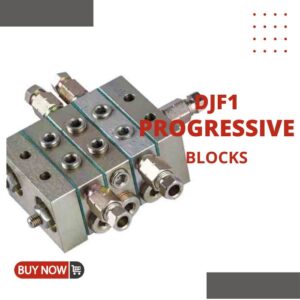
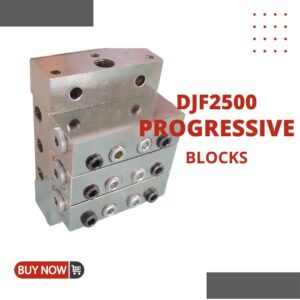
DJF-2000 Progressive Block for 25 MPa High-Pressure Systems
The DJF-2000 is a modular progressive distributor for centralized lubrication circuits where line pressure is high and the point count must follow the machine layout. The block takes 3 – 10 sections with 1 or 2 outlets per section, feeding up to 20 lubrication points at a maximum working pressure of 25 MPa. Metering is 0.16 – 1.12 ml/cycle per outlet, and the body is carbon steel. For the full range, browse the progressive distributors category.
How Sections and Outlets Add Up to Lubrication Points
Each section feeds 1 or 2 outlets. Sizing is plain arithmetic: sections x outlets per section = lubrication points. Worked example: 8 sections x 2 outlets = 16 points, so a machine with 16 points can use 8 dual-outlet sections. Section choice follows the machine layout; confirm the single-outlet and dual-outlet mix for your block when ordering. Because the same block style covers 3 – 10 sections, a machine that later gains lubrication points can be reconfigured by adding or swapping sections rather than replacing the whole assembly.
How 25 MPa Compares With the Standard 160 Bar Family
Standard progressive blocks are rated at 160 bar. Convert first: 160 bar = 16 MPa. Then divide: 25 / 16 = 1.5625, so the DJF-2000 handles roughly 1.6 times the pressure of the standard family. That margin fits machines with long feed lines, many points in series, or high back-pressure at the bearings. If your circuit runs at or below 160 bar and dose size is the real question, compare models on the JPQ progressive block page instead.
Specifications
| Maximum working pressure | 25 MPa |
| Minimum operating pressure | 1.4 MPa |
| Metering per outlet | 0.16 – 1.12 ml/cycle |
| Sections | 3 – 10, each with 1 or 2 outlets |
| Maximum lubrication points | 20 |
| Oil viscosity | N68 or higher |
| Grease consistency | NLGI #000 – #2 |
| Operating temperature | -20°C to +60°C |
| Inlet | M12x1.5 thread or 8 mm tubing, recommended tube length 1.5 – 4.5 m |
| Outlet | M10x1 thread or 6 mm tubing, recommended tube length 1.2 – 3.5 m |
| Body material | Carbon steel |
Typical Applications
DJF-2000 blocks are used on machine tools, conveyor lines, packaging machinery, bearing housings, and small gearboxes, where a progressive circuit must run at elevated pressure to overcome line and point resistance.
Honest Limitations Before You Order
- Minimum operating pressure is 1.4 MPa. A pump that cannot hold 1.4 MPa at the block inlet will not move the pistons through their full sequence, so verify pump capability first.
- Grease hardness tops out at NLGI #2. Harder greases are outside the stated range and can stall the metering pistons.
- Recommended tube lengths are 1.5 – 4.5 m on the inlet side and 1.2 – 3.5 m on the outlet side. Longer runs change pressure drop, so confirm the numbers with us and request a configuration quote before the layout is fixed.
Frequently Asked Questions
When do I need a 25 MPa high-pressure block instead of the standard 160 bar family?
Choose the DJF-2000 when system back-pressure is high, feed lines are long, or many points in series raise resistance past what a 160 bar block tolerates. For standard-pressure circuits, choose by dose on the JPQ page; for very small per-point doses, see the ZP-A progressive blocks page.
How do I match sections and outlets to my lubrication points?
Count the points, then pick 3 – 10 sections with 1 or 2 outlets each. Worked example: 8 sections x 2 outlets = 16 points. One assembly supports up to 20 lubrication points in total.
How much higher is 25 MPa than 160 bar?
Convert first: 160 bar = 16 MPa. Then divide: 25 / 16 = 1.5625, so 25 MPa is about 1.6 times the standard rating.
What does the minimum operating pressure of 1.4 MPa mean?
The pistons need at least 1.4 MPa at the inlet to complete their sequence. A pump that cannot hold that pressure at the block will stall the cycle, so check pump capability first.
Should I use single-outlet or dual-outlet sections?
Match the section to the machine geometry. Dual-outlet sections feed two nearby points from one section, while single-outlet sections suit isolated points. Confirm the section mix for your block when ordering.
What happens if one outlet gets blocked?
In a progressive circuit the pistons act in sequence, so one blocked outlet stops the cycle and pump pressure rises. Clear the blockage before restarting, and add pressure monitoring or overflow protection where a stalled cycle would go unnoticed.
Which lubricants can the DJF-2000 handle?
Oil with a viscosity grade of N68 or higher, and grease from NLGI #000 – #2. Media outside these ranges need review before ordering.
How do I connect the inlet and outlet ports?
The inlet is M12x1.5 thread or 8 mm tubing, with 1.5 – 4.5 m recommended tube length. Outlets are M10x1 thread or 6 mm tubing, with 1.2 – 3.5 m recommended. Longer runs need a pressure-drop check before you commit.
Do I need to re-bleed the block after adding or removing sections?
Yes. Any change inside the block disturbs the piston sequence, so bleed the assembly in order after the work is done.
Who makes the DJF-2000 and how do I order?
DJF-2000 blocks are made by IsoHiTech Lubrication Systems, founded in 2023, engineering since 2006. Email inquiry@isohitech.com or ask for a DJF-2000 quote with your point count and pressure conditions.