What the DJF3000 Does
The DJF3000 is a Series 3000 heavy-duty progressive divider for grease and oil. Each outlet delivers a large discharge per cycle, so the block suits machines that need substantial lubricant volumes at every point. Sections are carbon steel with zinc or nickel plating for hot and high-vibration locations. The block pairs with manual, motorized or pneumatic lubricators. Typical applications include large machine tools, harbor and material handling equipment, cement plants, and other heavy machinery. For medium-duty circuits, see DJF1000 progressive blocks.
Key Specifications
Ratings below cover the standard DJF3000 build. Confirm seal and thread options against your lubricant and ambient conditions.
| Parameter | Value |
|---|---|
| Outlets | 3-20 lubrication points |
| Valve sections | 3-10 per assembly |
| Discharge per outlet | 0.4-4.8 ml per cycle |
| Max working pressure | 25 MPa (3,625 psi) |
| Min operating pressure | 1.4 MPa (203 psi) |
| Standard seals | -20 to +60 C (high temperature options on request) |
| Oil | minimum viscosity grade 68 |
| Grease | NLGI 000 to 2 (grade 3 on request) |
| Material | carbon steel, zinc or nickel plated |
| Inlet | 3/8 BSP parallel, 10 mm tube (1.8-5.5 m runs) |
| Outlet | 1/4 BSP parallel, 8 mm tube (1.5-4.5 m runs) |
Model Table
Each section is ordered by size and outlet type. T sections carry two outlets, S sections carry one.
| Section | Part number | ml per cycle | Outlets |
|---|---|---|---|
| 3000-25T | 20730-25T | 0.40 | 2 |
| 3000-25S | 20730-25S | 0.80 | 1 |
| 3000-50T | 20730-50T | 0.80 | 2 |
| 3000-50S | 20730-50S | 1.60 | 1 |
| 3000-75T | 20730-75T | 1.20 | 2 |
| 3000-75S | 20730-75S | 2.40 | 1 |
| 3000-100T | 20730-100T | 1.60 | 2 |
| 3000-100S | 20730-100S | 3.20 | 1 |
| 3000-125T | 20730-125T | 2.00 | 2 |
| 3000-125S | 20730-125S | 4.00 | 1 |
| 3000-150T | 20730-150T | 2.40 | 2 |
| 3000-150S | 20730-150S | 4.80 | 1 |
T means twin outlets, S means single outlet. Cycle indicators fit 50T and 50S sections.
S and T Sections Explained
A T section serves two points from one piston stroke, splitting its rated volume between the two outlets. An S section serves one point with the full discharge. Mixing section sizes lets you tune the dose at each point on the same manifold, so a large bearing and a small slide can share one assembly. Cross-porting two outlets into a single line doubles the discharge delivered at that point. Use this where one remote point needs a heavier feed than the section can give alone.
How Progressive Metering Works
Inside the block, pistons stroke one after another in a fixed order. Each piston movement pushes a measured volume out of its outlet and mechanically triggers the next piston in the sequence. Because the pistons are interlocked, a block in any line stops the entire assembly. This protects the pump and lines from overpressure while the fault is present. A cycle indicator pin or proximity switch reports each completed cycle to a controller, so a stalled sequence is visible at the panel. Restore flow, and the sequence resumes from the stopped position.
Selection and Installation
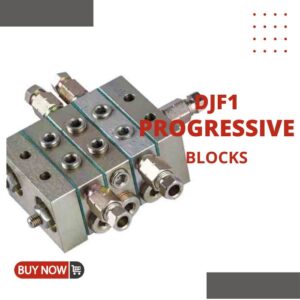
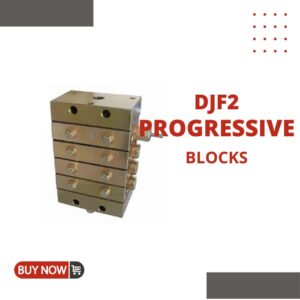
Count the points to be lubricated, from 3 to 20, then pick the discharge each point needs. Allow spare outlets for points added later. Thread options include BSP and metric on request. Assemble in order: inlet section, working sections, end section. Tighten the tie rods evenly so sections seat without distortion. Never run the block with a blocked outlet, because the interlock will stop the whole assembly. Mount away from impact and heat where possible. For medium-duty circuits, compare the DJF2000 progressive block and ZP-A progressive blocks, or send a quote request with your point list.
Frequently Asked Questions
What is a DJF3000 progressive block?
A heavy-duty divider manifold metering grease or oil to up to 20 points in sequence.
How is it different from the DJF1000?
It gives larger discharge per cycle and a 25 MPa rating for heavy machinery. See the DJF1000 page for medium-duty work.
Which lubricants can it handle?
Oil of viscosity grade 68 minimum, or NLGI 000 to 2 grease.
What pressure range does it work in?
1.4 MPa minimum, 25 MPa maximum.
What temperatures are allowed?
-20 to +60 C with standard seals. High temperature seal options are available on request.
What happens if an outlet blocks?
The whole block stops. Clear the line, then restart.
Can sections be added later?
Yes. Insert working sections between the inlet and end sections.
Where do cycle indicators fit?
On 50T and 50S sections, as indicator pins or proximity switches.
What is cross-porting?
Joining two outlets into one line to double the discharge delivered there.
Who builds these blocks?
IsoHiTech Lubrication Systems, founded in 2023, engineering since 2006, builds and supports every unit. Email inquiry@isohitech.com for specifications and a quotation.
For help pairing sections to each point, reach us through the quote request page.