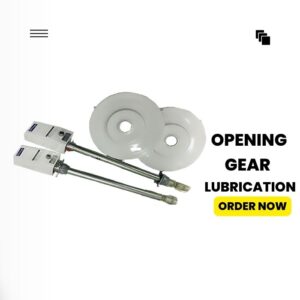
What This System Is
The pneumatic drum unloading system from IsoHiTech Lubrication Systems is an integrated transfer station for high-viscosity materials – printing inks, coatings, adhesives, and pastes from 500 to 150,000 cPs – in 200 kg (55 gallon) open-head drums. It combines a double-post pneumatic hoist, a follower (inductor) plate, and an air-operated piston pump in one frame. With the pump ratio specified at order (20:1, 40:1, or 60:1), output reaches up to 360 bar (5,220 PSI) at 6 bar air inlet.
This is not an ordinary drum pump. A dip-tube pump sucks fluid and fails on thick material: it cavitates, draws air, and leaves 15-20% of the drum’s content on the walls. The follower plate presses material into the pump inlet, seals against the drum wall, and wipes the wall as it descends. The design target is 98-99% drum evacuation; actual recovery depends on viscosity, drum condition, and seal fit (see the FAQ for honest figures).
Pump Ratio Options
| Parameter | 20:1 Ratio | 40:1 Ratio | 60:1 Ratio |
|---|---|---|---|
| Output pressure at 6 bar air | 120 bar | 240 bar | 360 bar (5,220 PSI) |
| Maximum flow | 25 L/min | 18 L/min | 12 L/min |
| Minimum flow | 2 L/min | 1.5 L/min | 1 L/min |
| Air consumption (pump) | 250 NL/min | 300 NL/min | 350 NL/min |
| Viscosity range | 500-50,000 cPs | 10,000-100,000 cPs | 25,000-150,000 cPs |
System Specifications
| Parameter | Specification |
|---|---|
| Drum compatibility | 200 kg (55 gal) open-head steel or rigid drums |
| Total viscosity range | 500-150,000 cPs |
| Wetted parts | Stainless steel 316L; seals in PTFE, NBR, or Viton |
| Follower plate | 457-558 mm diameter (sized to drum ID minus 2 mm), 10-15 mm thick; aluminum 6061-T6, SS304, or SS316L |
| Hoist | 900-1200 mm travel; 150 kg max load (pump + plate + residual); carbon steel powder-coated frame |
| Air supply | 5-8 bar (6 bar optimal); peak consumption 400-500 NL/min at 6 bar |
| Compressor guidance | 0.5-1.0 m3/min at 7 bar |
| Drum evacuation time | 15-45 minutes, viscosity dependent |
| Drum changeover | 2-3 minutes |
| Temperature | Ambient 5-45°C; material 10-80°C (heating option available) |
| Installation | 4x M12 floor anchors; floor loading 500 kg/m2 minimum; 2.5 m overhead clearance |
Material Compatibility Guide
| Material | Viscosity (cPs) | Recommended Ratio |
|---|---|---|
| Flexographic inks | 500-5,000 | 20:1 |
| UV printing inks | 5,000-25,000 | 20:1 or 40:1 |
| Offset (sheetfed) inks | 10,000-50,000 | 40:1 |
| Pharmaceutical creams | 10,000-50,000 | 40:1 |
| Screen printing inks | 15,000-80,000 | 40:1 or 60:1 |
| Industrial coatings | 20,000-100,000 | 60:1 |
| Hot-melt adhesives | 50,000-150,000 | 60:1 |
Safety and Operation
The hoist includes descent speed limiting and a load-holding valve, so the plate assembly locks in place if air supply is lost, plus overpressure relief on the pneumatic circuit. In operation, three forces – pump suction, pneumatic down-force, and the weight of the assembly – feed material continuously without cavitation until the plate reaches the drum bottom.
Limitations to Know Before Ordering
- Drums must be rigid: open-head steel or rigid plastic with a wall of 2 mm or more and a reinforced rim. Fiber drums and thin-walled pails deform under plate pressure and break the seal – they are not usable.
- For thin, free-flowing oils this system is overkill – a simple 1:1 air-operated drum transfer pump does that job at a fraction of the cost.
Maintenance Schedule
| Interval | Task |
|---|---|
| Daily | Visual check: leaks, seal condition, hose wear |
| Weekly | Clean follower plate and seal; check hoist travel |
| Monthly | Lubricate hoist guide rails; drain air filter unit |
| Quarterly | Replace air filter element; inspect pump piston seals |
| Semi-annual | Replace follower plate seal |
| Annual | Replace pump fluid-section seal kit; full system inspection |
Optional accessories – drum scales, remote control, distribution manifolds, heated hoses, level sensors, PLC interface modules – are available; confirm configurations at order.
For sizing help, send your material, viscosity, and target flow rate to inquiry@isohitech.com or contact us for a quote.
If you already know your ratio and plate material, request a system quotation directly.
Frequently Asked Questions
What is a pneumatic drum unloading system, and how is it different from a drum pump?
It is a hoist, follower plate, and piston pump working as one unit to empty high-viscosity material from 200 kg drums. A plain drum pump sucks fluid through a dip tube; the follower plate rides on the material surface, pushing it into the pump inlet while its seal wipes the drum wall. That prevents cavitation and air entrainment and recovers nearly all the drum contents – which suction pumping cannot do on thick material.
How do I choose between the 20:1, 40:1, and 60:1 ratios?
Start with viscosity: 500-50,000 cPs points to 20:1, 10,000-100,000 cPs to 40:1, and 25,000-150,000 cPs to 60:1. Then check flow: the 20:1 delivers up to 25 L/min, the 60:1 only 12 L/min. Finally check pressure: at 6 bar inlet the ratios output 120, 240, and 360 bar – air pressure multiplied by ratio. Specify the ratio at order.
Is the 98-99% evacuation figure realistic?
It is the design target under good conditions, not a guarantee. Actual recovery depends on viscosity, drum wall condition, and seal fit. Typical residual is under 2 kg per drum; above 100,000 cPs, expect 3-5 kg. Plan material costing on those figures, not on zero waste.
How do I size the air compressor?
Peak consumption with pump and hoist running together is 400-500 NL/min at 6 bar. A compressor rated 0.5-1.0 m3/min at 7 bar covers one system; add roughly 20% headroom for compressor cycling and expansion.
Can I use plastic drums?
Only rigid ones. The wall must be at least 2 mm thick with a reinforced rim so it does not bulge under the plate’s down-force. Fiber drums, thin-walled pails, and collapsible containers deform, break the plate seal, and are not suitable.
What happens if the air supply fails mid-cycle?
Descent speed limiting prevents the plate assembly from falling, and the load-holding valve locks the hoist in position. The system stays safely in place until air is restored.
How long does a drum change take?
About 2-3 minutes with a trained operator: stop the pump, raise the plate assembly, swap the drum, and lower the plate onto the new material surface.
How do I clean the system between materials?
The follower plate and fluid lines are removable for manual cleaning, and a compatible solvent can be circulated through the pump and discharge line. Verify solvent compatibility with your seal material (PTFE, NBR, or Viton) first.
Can it feed a filling line or mixer directly?
Yes – direct supply to production equipment is a primary use case, and the 120-360 bar output range covers long pipe runs. For simple low-pressure drum-to-container oil transfer elsewhere in the plant, see our 50 gallon air-operated oil transfer pump.