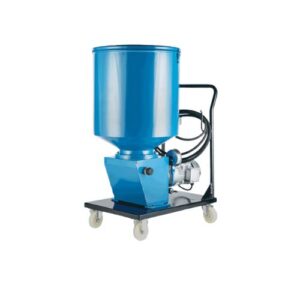
What the DR4-5 Valve Does
The DR4-5 is the reversing valve of a dual-line centralized lubrication system. A dual-line system runs two distribution mains, and the valve alternates supply pressure between them so one main is pressurized while the other vents to the reservoir. The valve shifts using the pressure difference itself, so no electric control is needed; an optional limit switch reports spool position to a panel. This page carries the DR4-5 numbers and setup. The family principle behind hydraulic reversing is covered on the SYP hydraulic reversing valve page.
The DR4-5 is a hydraulic reversing valve for dual-line lubrication systems — the changeover station that flips supply between Line A and Line B. Parts lists also write it as DR45 or DR 4/5: same valve, same function. This is our own manufacture, built as a direct replacement wherever a DR4-5 / DR45 reversing valve is specified.
Specifications
| Item | Declared value |
|---|---|
| Switching pressure adjustment range | 500-3,500 PSI (35-240 bar) |
| Factory switching setting | 1,500 PSI |
| Maximum non-shock working pressure | 5,000 PSI |
| Flow capacity | 0.5-5.0 L/min |
| Pressure drop | below 50 PSI at 2 L/min |
| Grease handled | NLGI 000 to 2 |
| Oil viscosity handled | 32-1,500 cSt at 40°C |
| Adjustment resolution | about 200 PSI per turn of the set screw |
| Optional position switch | SPDT contacts, 5 A at 250 VAC |
How Hydraulic Reversing Works
Both mains connect to the ends of the valve spool. When the metering devices on the pressurized main finish their stroke, that main can take no more grease and line pressure rises. The pressure rise acts on the spool end and, once it passes the switching threshold, drives the spool across to its other position. Supply now feeds the second main while the first main vents through the drain. The cycle repeats with every stroke of the system, and the only signal the valve needs is the pressure wave itself. That keeps the control simple, but it also defines the honest limit of the valve: it reports that pressure shifted, not that grease arrived at every bearing.
Setting the Switching Pressure
The switching pressure adjusts with a set screw, about 200 PSI per turn, across a range of 500-3,500 PSI (35-240 bar). The valve leaves the factory set at 1,500 PSI, which suits many medium systems. Set the threshold above the normal working pressure of a full main so the valve shifts only when that main is genuinely finished, not while grease is still moving. If the pump cannot reach the set threshold, the valve never shifts; check the pump rating against your setting before commissioning. Ordering codes cover body, spool, port, and material options, so describe the required combination when ordering rather than quoting a code from memory.
Ports and Mounting
| Port | Function | Thread options |
|---|---|---|
| P | Pressure inlet from the pump | 1/4 NPT, G1/4, or M14x1.5 |
| A and B | Distribution mains | 1/4 NPT, G1/4, or M14x1.5 |
| T | Drain | 3/8 NPT, G3/8, or M16x1.5 |
G parallel and NPT threads are not interchangeable, and the same applies to the metric M threads, so confirm the port thread forms when ordering. Mount the valve near the pump, upstream of the two mains, and keep the drain line short: a long, restricted drain vents slowly and delays the shift. For help matching the valve to your pump and mains, use our quote request page.
Related Dual-Line Components
If the system needs electric shifting instead of hydraulic, see the 24EJF-P solenoid reversing valve. Because the DR4-5 proves the mains shifted rather than delivery at each point, pair it with an end-of-line YCK pressure switch. The mains feed SDPQ dual-line metering valves at the distribution points, and the supply side starts at an electric grease pump.
Frequently Asked Questions
How does the valve know when to reverse?
When the metering devices finish, the main can take no more grease and pressure rises. That rise pushes the spool across once it passes the switching threshold.
How is it different from the electric-solenoid valve?
The DR4-5 shifts hydraulically from the pressure wave, with no solenoid. The 24EJF-P uses an electric solenoid to shift the spool on command.
Where should I mount it?
Near the pump, upstream of both mains, with the drain line kept short. Long drain runs vent slowly and delay the shift.
What happens if a main blocks?
Pressure climbs toward the pump relief instead of signaling completion, and shifting becomes erratic. Stop the system and clear the blockage.
What do switching pressure and maximum pressure mean?
Switching pressure is the threshold that trips the spool, adjustable from 500 to 3,500 PSI. Maximum pressure is the 5,000 PSI non-shock working ceiling.
How do I adjust the switching pressure?
Turn the set screw, about 200 PSI per turn. The valve ships set at 1,500 PSI.
Which port threads can I order?
P, A, and B come in 1/4 NPT, G1/4, or M14x1.5; the drain T comes in 3/8 NPT, G3/8, or M16x1.5. Confirm the thread forms when ordering.
Which grease grades can it handle?
It handles grease from NLGI 000, the softest grade, to NLGI 2. It also handles oil from 32 to 1,500 cSt at 40°C.
Does the valve prove grease reached each bearing?
No, it only proves the pressure shifted the mains. Pair it with the YCK end-of-line pressure switch; request a quote for the pair.
Who builds the DR4-5?
IsoHiTech Lubrication Systems, founded in 2023, engineering since 2006, builds and supports every unit. Email inquiry@isohitech.com for specifications and a quotation.
DR4-5, DR45, or DR 4/5 — which one is it?
The same valve. DR4-5 is the hyphenated catalog form; DR45 is how parts lists compress it. The valve on this page is our own build, made to drop into systems that call for either code.
Does the DR4-5 replace a Farval DR45?
Farval marketed a DR4-5 reversing valve for dual-line systems with the same changeover function. Match porting and pressure setting to your line size before substituting across brands — the function is shared, the mounting is not always.