What an FL33 Injector Does
The FL33 injector meters a precise volume of grease into one lubrication point on a single-line system. It receives grease under pressure, stores a measured charge, and discharges that charge only when the supply line pressure vents.
Each injector serves one bearing or wear point, so a bank of injectors can lubricate many points from one pump. The discharge per cycle is adjustable from 0.016 to 0.049 cc, which lets you match output to the bearing requirement.
This injector works with grease up to NLGI 2 and mounts directly at the point or on a manifold. It is a common choice for machines where each point needs a different volume and independent operation.
For a broader view of how these components fit a complete circuit, see the single-line lubrication system overview.
The Pressure-Vent Cycle
A single-line injector works in two phases. First the pump raises line pressure above the minimum operating pressure, and the injector discharges its stored volume to the bearing.
Second the pump stops and the line vents toward the reservoir. The injector can only reset and refill for the next cycle when the vent pressure drops below the maximum vent pressure of 200 psi.
If the line does not vent low enough, the injector will not reset. This is why the vent side of the system matters as much as the pressure side.
| Pressure Window | Value | Why It Matters |
|---|---|---|
| Minimum operating pressure | 1,200 psi (82 bar) | Below this the injector may not discharge fully |
| Maximum operating pressure | 3,500 psi (238 bar) | Upper limit for normal operation |
| Maximum vent pressure | 200 psi (14 bar) | Line must drop below this for reset |
The discharge happens quickly once the opening pressure is reached. The reset happens only after the pressure falls, so a blocked vent or a closed return path will stop the injector from cycling.
Setting the Output
Output is set with the indicator cap on top of the injector. The full range from 0.016 to 0.049 cc per cycle is covered by about 2 full turns of the cap.
Always set the output with the line depressurized. Adjust in quarter-turn steps, then run a cycle and verify delivery at the point before making another change.
Turning the cap further than the two-turn span adds nothing. The internal stop limits the stroke, so extra turns will not increase the discharge beyond the maximum.
When you change output, watch the indicator cap movement during the next cycle. A full visible stroke confirms the injector is cycling, while a short or missing stroke points to a pressure or reset problem.
Specifications
| Parameter | Value |
|---|---|
| Minimum operating pressure | 1,200 psi (82 bar) |
| Maximum operating pressure | 3,500 psi (238 bar) |
| Maximum vent pressure | 200 psi (14 bar) |
| Discharge per cycle | 0.016-0.049 cc (0.001-0.003 cu in) |
| Adjustment range | About 2 full turns of the indicator cap |
| Operating temperature | -10 to 350 degrees F (-23 to 176 degrees C) |
| Body material | Carbon steel or 304 stainless with zinc protection |
| Seal material | FKM |
| Inlet | 1/8 inch NPTF female |
| Outlet | 1/8 inch OD tube |
| Grease compatibility | Up to NLGI 2 |
| Mounting | Single or manifold |
The carbon steel body with zinc protection suits general industrial use. The 304 stainless body is available for washdown or corrosive environments.
Single and Manifold Mounting
An FL33 injector can be mounted directly at the lubrication point with a short outlet tube. This keeps the discharge path short and reduces the chance of a blocked line between injector and bearing.
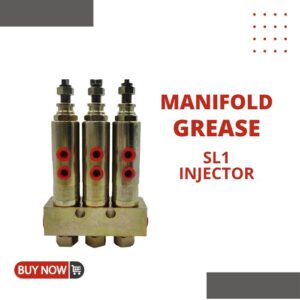
Manifold mounting groups several injectors on one block fed by a common inlet. This simplifies plumbing and makes it easier to inspect a row of injectors at one location.
Use a single mount when the point is far from other points or when the outlet tube must be very short. Use a manifold when several points are close together and you want a cleaner installation.
For manifold assemblies and individual units, browse the lubrication injector category.
Injector or Progressive Divider
A single-line injector system lets one injector stop feeding while the others continue. A progressive divider system works differently: if one divider outlet blocks, the whole divider stops, which can reveal a fault sooner.
Choose an injector system when each point needs its own adjustable volume and independent operation. Choose a progressive divider when you want a fixed, sequential output and a single point of blockage to stop the entire group.
Injector systems also allow a simpler supply line because each injector stores and discharges its own charge. Progressive systems depend on a moving piston train, so all outlets fire in order on every cycle.
If your machine has many points with different grease requirements, the FL33 injector approach is often easier to tune. If the points need identical volume and you want a hard stop on blockage, consider mono progressive blocks.
For a complete single-line circuit, the pump element and pressure valve also matter. A common pump element is the EP-120 pump element, and the YCK pressure valve controls the vent side.
If you are still deciding between system types, talk to an application engineer before you commit to a layout.
Frequently Asked Questions
How do I know the injector is delivering grease?
Watch the indicator cap on top of the injector during a pressure cycle. A full visible stroke means the injector discharged its set volume.
Can the FL33 handle synthetic grease?
Yes, the injector works with grease up to NLGI 2 consistency. Synthetic grease is fine as long as it falls within that consistency range.
What is the minimum line pressure for the FL33?
The minimum operating pressure is 1,200 psi. Below that the injector may not discharge its full set volume.
Can I adjust the output while the system is running?
No, always depressurize the line before turning the indicator cap. Adjusting under pressure can damage the internal stop or give a false setting.
What is the difference between vent pressure and operating pressure?
Operating pressure is the high pressure that forces the injector to discharge grease. Vent pressure is the low pressure the line must reach for the injector to reset.
My injector stopped cycling, what should I check first?
Check the outlet tube and the grease condition at the point first. A blocked tube or hardened grease is the most common cause.
Can one injector fail while the others keep working?
Yes, that is normal for a single-line injector system. Each injector operates independently, so one blocked point does not stop the others.
Should I mount the FL33 single or on a manifold?
Mount single when the point is isolated or the outlet tube must be very short. Mount on a manifold when several points are close together and you want simpler plumbing.
How is this different from a progressive divider system?
A progressive divider fires all outlets in a fixed sequence and stops if one outlet blocks. An injector system lets each point fire independently and at its own set volume.
Where can I order FL33 injectors or manifold assemblies?
IsoHiTech Lubrication Systems, founded in 2023, engineering since 2006, builds and supports every unit. Email inquiry@isohitech.com for specifications and a quotation.
For pricing and availability, request a quote here.