Overview
A hand grease pump uses a lever to move grease from a canister, pail or drum to a grease fitting, with no power supply and no air line. This page guides you across three configurations: compact canister pumps for occasional top-ups, bucket-mounted lever pumps for daily workshop use, and drum-mounted pumps with follower plates for high-frequency work.
Already set on a specific lever bucket pump with published specifications? Go to the hand grease filler pump page. Still choosing between manual, electric and air-operated drive types? Start with the complete guide to grease pumps.
Three Configurations at a Glance
| Configuration | Container | Typical use |
|---|---|---|
| Compact hand pump | 0.5 – 1 kg canister | Occasional top-ups, mobile service kits |
| Bucket-mounted lever pump | 5 – 20 kg pail | Workshops, farms, fleet maintenance |
| Drum-mounted lever pump | 50 kg drum with follower plate | High-frequency, high-volume greasing |
Bodies are carbon steel, cast iron or aluminum alloy by model; seals are NBR standard, FKM for high temperature or synthetic greases. When manual output is not enough, the grease pump hub page covers electric and air-operated alternatives.
How the Lever and Check Valves Work
Each lever stroke drives a hardened plunger through the pump chamber. Inlet and outlet check valves open in sequence: the inlet admits grease as the plunger retracts, the outlet feeds the hose as it advances. The valves stop backflow, so the line keeps residual pressure and the next stroke delivers immediately.
The pressure a pump develops depends on its lever ratio and plunger bore; confirm the rated value for your model against your fitting back pressure before ordering.
Compact and Bucket-Mounted Pumps
Compact pumps carry a 0.5 – 1 kg canister and fit in a service-van tool box, suiting machines with a few fittings to top up.
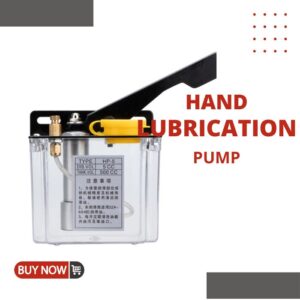
Bucket-mounted lever pumps clamp onto a 5 – 20 kg pail: easy refills, direct feel of fitting resistance, easy movement between machines. Farms and small fleets standardize on it.
Drum-Mounted Pumps and Follower Plates
For high-frequency greasing, a lever pump on a 50 kg drum ends the constant-refill chore. The follower plate, a disk that rides the grease surface down as the level drops, wipes the drum wall, stops air pockets at the suction inlet and keeps suction steady with stiff grease. For sizing, see the follower plate page.
Grease Grades and Cold Weather
Hand pumps here handle NLGI 000 – 2 greases as routine work. Grade 3 needs a higher lever ratio and gets hard to pump at low temperature, so treat it as a special case. Cold weather stiffens any grease; bring the container indoors before a shift.
Hose, Coupler and Thread
Delivery hoses run 300 mm – 1,500 mm by configuration, built as hydraulic-grade braided hose. Coupler threads follow three standards: 1/8″ NPT, DIN 71412 and M10x1. Check the thread on your equipment before ordering; a coupler that almost fits will not seal.
Honest Limitations
- Pressure capability is model-specific; this page carries no pressure rating, so confirm your model’s value against your fitting back pressure.
- NLGI Grade 3 and cold grease both raise lever effort significantly.
- A bucket pump without a follower plate can draw air at low grease level.
- Output per stroke varies by model; grease quantity per fitting follows the equipment builder’s lubrication specification, not a formula.
Not sure which configuration matches your grease and fittings? Describe your application to our team and we will narrow it down.
Frequently Asked Questions
Which configuration should I buy: compact, bucket or drum?
Match container to your greasing rhythm: compact canisters for occasional top-ups, bucket pumps for daily workshop use, drum pumps with follower plates for high-frequency lines.
How much force does the lever take?
It depends on grease grade and temperature. NLGI 000 – 1 pumps easily, NLGI 2 takes firm effort, Grade 3 or cold grease is much harder.
How much grease does one stroke deliver?
Output per stroke is model-specific; confirm the figure for your model. Per-fitting quantity follows the equipment builder’s lubrication specification, not a formula.
Does pressure or volume matter more when choosing?
Both: enough pressure for your tightest fitting, enough volume per stroke that greasing stays quick. Confirm both ratings for your model.
What does a follower plate actually do?
It rides the grease surface down, wipes the drum wall and stops air pockets at the suction inlet. Without one, a pump can lose prime early.
How do I match a follower plate to my drum?
Match plate diameter to the drum’s inside diameter and confirm drum size, such as 50 kg. Too small lets grease bypass the edge; too large will not enter.
Which coupler thread do I need?
Check existing couplers against the three standards in the hose section above; a thread that almost fits will not seal.
How long should the hose be?
Hoses run 300 mm – 1,500 mm by configuration. Pick the shortest length that gets the coupler to every fitting.
The pump stopped delivering grease. What do I check?
Look for air drawn in at low level, a nearly empty container, a blocked coupler, hardened grease, or a stuck follower plate. If it persists, send us a description of the symptoms.
Who is behind these hand grease pumps?
IsoHiTech Lubrication Systems, founded in 2023, engineering since 2006, builds manual, electric and air-operated lubrication equipment. For selection help and quotations, contact inquiry@isohitech.com.