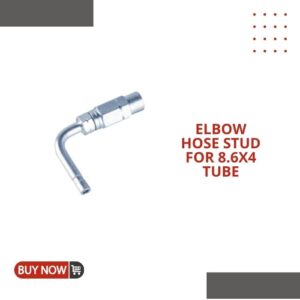
What Hose Ends and Studs Do
Hose ends and remote grease studs are the line-side hardware of a lubrication system. A remote stud relocates a point to a reachable spot; a hose end joins a line to the stud, a manifold, or a tube run. Gun-side hardware is covered in the grease lubrication fitting guide.
Hose End Types: Reusable, Crimp, Swivel
Reusable hose ends assemble on site with hand tools and top out around 1,000 PSI (70 bar). Crimp-on ends are assembled once with a crimping machine and reach up to 3,000 PSI (207 bar); dimensions must follow the maker’s chart.
Swivel hose ends let the line rotate during installation, removing twist and easing routing into a tight bend. A swivel’s rating is set by the hose assembly and the swivel seal, not the end alone.
Remote Lubrication Studs (surface-mount and bulkhead)
A surface-mount stud fixes to a bracket or frame with its port facing outward, typically M10 x 1.0 or 1/8″ NPT. A bulkhead stud passes through a panel and locks on both sides, and comes in 1/8″ NPT, 1/4″ NPT, M10 x 1.0 and other metric sizes.
Both styles are remote points, not fittings. The nipple the grease gun couples to is separate – see the grease nipples range and the nipple caps and covers range.
Thread Identification
Taper threads look alike and are not interchangeable. NPT and BSPT share the same 1 degree 47 minute taper but differ in pitch, so a 1/8″ NPT fitting will start into a 1/8″ BSPT port and bind before it seals.
| Thread | Threads per inch | Major diameter |
|---|---|---|
| 1/8″ NPT | 27 TPI | 0.405″ |
| 1/4″ NPT | 18 TPI | 0.540″ |
| 3/8″ NPT | 18 TPI | 0.675″ |
| 1/8″ BSPT | 28 TPI | 0.383″ |
| 1/4″ BSPT | 19 TPI | 0.518″ |
Metric ports are named by size and pitch together: M8 x 1.0, M10 x 1.0, M10 x 1.25 and M12 x 1.5. Do not mix thread families across one line: compression straight tube fittings or push-to-connect grease line fittings.
Assembly Torque Reference
Clean both threads and apply tape in the direction of travel by hand; torque figures are a ceiling, not a target. Reduce the figure on a casting or thin-wall manifold.
| Port size | Zinc-plated steel | 316 stainless | Brass |
|---|---|---|---|
| 1/8″ NPT | 8-10 ft-lbs | 6-8 ft-lbs | 5-7 ft-lbs |
| 1/4″ NPT | 15-18 ft-lbs | 12-15 ft-lbs | 10-13 ft-lbs |
| M10 x 1.0 | 20-25 ft-lbs | 15-20 ft-lbs | 12-18 ft-lbs |
Material Options
Selection is driven by the environment around the joint, not the lubrication pressure.
| Material | Tensile strength | Typical use |
|---|---|---|
| Zinc-plated steel | About 400 MPa | General machine frames, indoor plant, most OEM build work |
| 316 stainless | At least 515 MPa | Washdown, marine, chemical and high chloride resistance environments |
| Brass (C36000) | At least 380 MPa | Food processing environments, instrumentation, low-load brackets |
Steel is the default where the joint stays dry; 316 stainless earns its place where chlorides or repeated washdown would corrode a plated finish. Brass machines cleanly and is non-sparking.
Planning a Remote Point
Work through the sequence in order.
- Pick the point and confirm its port thread.
- Route the shortest path, avoiding heat and sharp edges.
- Clip or bracket the hose at regular intervals.
- Fit the hose end, then install the stud.
- Pressurize in steps and check for weeping.
If you would rather not assemble the run piece by piece, the pre-built kit on the remote grease line with reusable fittings page arrives as a matched set. You can also contact us for a quote and we will confirm the parts against your machine.
Frequently Asked Questions
Should I choose reusable or crimp-on hose ends?
Choose reusable ends when working pressure stays at or below 1,000 PSI (70 bar) and you want to rebuild on site. Choose crimp-on ends for permanent runs up to 3,000 PSI (207 bar).
How do I identify the thread on my equipment?
Measure the major diameter with a caliper and count the threads per inch with a pitch gauge. A 1/8″ NPT port reads 27 TPI at 0.405″.
What is the difference between a stud and a hose end?
A stud relocates the lubrication point to a reachable spot, either surface-mounted or through a panel. A hose end terminates the flexible line and joins it to that stud.
How do I match bulkhead thread length to panel thickness?
Measure the panel at the hole, including paint or coating, then select a stud whose threaded length leaves enough turns for the locknut. Too long intrudes into the working area.
What does the 1,000 PSI reusable hose end limit suit?
It suits low-pressure return lines and the mid-lines of a multi-point system, where pump outlet pressure has already been reduced. High-pressure runs belong on crimp-on ends.
When is 316 stainless required instead of plated steel?
Specify 316 stainless where the joint sees washdown, marine air, or chemical exposure, because it resists chlorides. Indoor machine frames are fine with zinc-plated steel.
Does a taper thread need sealant tape?
Yes. Taper threads seal by interference between the engaged turns, so sealant tape fills the spiral gap and lubricates assembly. Parallel threads rely on a bonded seal instead.
Can I buy a complete pre-assembled kit instead of parts?
Yes. The remote grease line kit page lists pre-assembled runs built with reusable fittings. Send your point count, thread sizes, and panel thickness for confirmation.
How do I verify a finished assembly?
Clean and dry every joint, then raise the pressure in steps and watch for weeping at each stage. A joint showing fresh lubricant needs re-seating, not more torque.
Who can I contact about hose ends and remote grease studs?
IsoHiTech Lubrication Systems, founded in 2023, engineering since 2006, will confirm thread, material, and torque details against your equipment. Email inquiry@isohitech.com with your port sizes, or use the quote request form.