What the JPQ Family Does
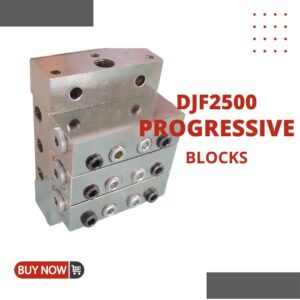
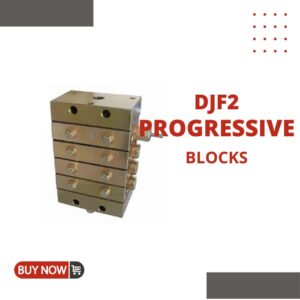
The JPQ progressive block is a family of sequential metering distributors for centralized lubrication. Internal pistons displace lubricant one outlet at a time in a fixed order, so each point receives a measured dose per cycle. Four models, JPQ1-K through JPQ4-K, share one working principle and differ in metering rate and segment count. Typical uses include machine tools, conveyor lines, packaging machinery, bearing housings, and small gearboxes; browse the progressive distributors category for the full range.
JPQ1 to JPQ4 Model Overview
Unlisted figures are confirmed at order.
| Model | ZP equivalent | Metering per outlet (ml/stroke) | Segments | Outlets |
|---|---|---|---|---|
| JPQ1-K | ZP-A | 0.07, 0.1, 0.2, 0.3 | 3 – 12 | 6 – 24 |
| JPQ2-K | ZP-B | 0.5, 1.2, 2.0 | Confirm at order | Confirm at order |
| JPQ3-K | ZP-C | 0.07 – 0.3 | 4 – 8 | 6 – 14 |
| JPQ4-K | ZP-D | 0.5, 1.2, 2.0 | 4 – 8 | Confirm at order |
JPQ to ZP Model Mapping
These blocks also appear under ZP designations in replacement and procurement documents. The published mapping: JPQ1-K = ZP-A, JPQ2-K = ZP-B, JPQ3-K = ZP-C, JPQ4-K = ZP-D. Match the letter suffix to the JPQ number before ordering. The small-dose member is covered on the ZP-A progressive blocks page.
Choosing by Dose Level
Start from the dose each point needs per cycle. Small doses of 0.07 – 0.3 ml/stroke point to JPQ1-K or JPQ3-K, for small bearings and precision points where over-lubrication is the risk. Larger feeds of 0.5, 1.2, or 2.0 ml/stroke point to JPQ2-K or JPQ4-K, for larger bearings and more open geometry. JPQ1-K covers 6 – 24 outlets over 3 – 12 segments; JPQ3-K covers 6 – 14 outlets over 4 – 8.
Rated working pressure is 160 bar (16 MPa); some models allow 16 – 20 MPa (160 – 200 bar), and some are rated 30 MPa (300 bar). Systems above that class belong to the DJF-2000 family.
Operating Limits and Lubricants
The blocks work from -30°C to +80°C in a high carbon steel body. Grease: penetration of 290 or higher (25°C, 150 g, 1/10 mm), filtered to 100 micron or finer, NLGI 0 – 2. Oil: 17 cSt or higher, filtered to 25 micron or finer. Grease outside NLGI 0 – 2 resists piston movement; coarse contamination accelerates wear.
Limits to Plan For
- The piston train is one chain: if an outlet blocks, sequencing stops and supply pressure rises; add a pressure switch, cycle indicator, or relief protection to catch it.
- NLGI 0 – 2 and 100 micron grease filtration are hard limits; confirm anything outside them before use.
- Flush pump and lines before changing grease type; mixed thickeners can harden in the lines and the block.
- JPQ2-K segment and outlet counts are confirmed at order; do not assume they match other models.
Tell us your point count, dose per point, and working pressure and we will narrow the four models to one configuration. Send us your point count and dose requirements to confirm model, segments, and threads.
Frequently Asked Questions
How do I choose between JPQ, ZP, and the DJF-2000 family?
Start with dose per point: 0.07 – 0.3 ml/stroke means JPQ1-K (ZP-A) or JPQ3-K (ZP-C); 0.5 – 2.0 ml/stroke means JPQ2-K (ZP-B) or JPQ4-K (ZP-D). Above the 160 bar class, use the DJF-2000 progressive block page.
What does 0.2 ml/stroke mean for one outlet?
It is the volume displaced at that outlet each time its piston completes a working stroke in a cycle. Delivery over time depends on how often the pump cycles the block.
How do I convert ml/stroke to grease supply per point?
Multiply metering rate by cycling rate: ml/stroke x cycles/min = ml/min per outlet. Example: 0.2 ml/stroke x 60 cycles/min = 12 ml/min per outlet; use your real cycling rate.
What happens if one outlet gets blocked?
Sequencing stops at the blocked piston and supply pressure rises while the pump keeps delivering. Add a pressure switch, cycle indicator, or relief valve so the stall is caught quickly.
Does a cycle indicator prove every point received grease?
No. It proves the monitored piston completed its cycle; a blocked line downstream can still leave points dry while the indicator cycles normally. Pair it with periodic checks.
Which greases work in these blocks?
Stay within NLGI 0 – 2, penetration of 290 or higher (25°C, 150 g, 1/10 mm), filtered to 100 micron or finer. Harder or coarser greases resist the pistons and accelerate wear.
How do I confirm inlet and outlet threads?
Match the inlet to the pump connection and outlets to your line fittings, and state both with your order; measure existing threads on older installations rather than assuming.
When do JPQ2-K and JPQ4-K large-dose models make sense?
Where each point needs more lubricant per cycle: larger bearings, open bearing arrangements, points with more clearance or a leakage path. A 2.0 ml/stroke dose on a small precision point risks over-lubrication.
Can I add or remove segments after installation?
Segment count is set at the order stage within each model’s range: JPQ1-K spans 3 – 12 segments, JPQ3-K and JPQ4-K span 4 – 8. Field changes need re-bleeding in sequence before return to service.
Who supplies the JPQ family and how do I order?
IsoHiTech Lubrication Systems supplies the JPQ family with pumps, tubing, and monitoring accessories. We were founded in 2023, engineering since 2006. Send your point count and system pressure to inquiry@isohitech.com or request a quotation here.