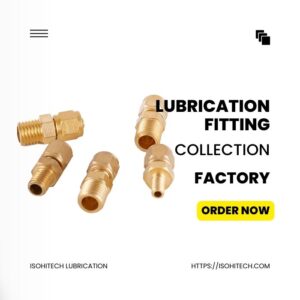
Lincoln SSV divider valve fittings are the threaded connectors that join grease feed lines to SSV and SSV-M progressive divider valve outlets. Rated up to 350 bar (5,076 psi) and from -30°C to +100°C (-22°F to +212°F), they come in two outlet threads: M10x1 for the SSV and M8x1 for the compact SSV-M. Your valve model – from the nameplate or manual, not appearance – decides which thread you order. These compatible fittings are chosen by thread size and torque family, not brand. The valves they serve are in our progressive distributors category.
How the Valve Drives Fitting Choice
A progressive divider valve meters grease one outlet at a time: an internal piston steps forward on each cycle and grease leaves through the opened outlet. The cycle is driven by grease displaced through outlets 1 and 2, so those outlets must always carry feed lines – plugging either one stops the whole valve. All other outlets take a feed line or a matching closure plug. The cycle logic is covered in the working principle of the grease distributor block.
Fitting and Accessory Types
Seven fitting families cover tubing runs, hose connections, backflow control, and unused outlets.
| Fitting type | Use | Size or thread |
|---|---|---|
| Compression | Steel or nylon tubing runs | 1/4″ OD tube, 1/8″ NPTF |
| Quicklink knurled collar | Tool-free connect and disconnect | 1/4″ OD nylon tube, finger-tight |
| Quicklink reinforced collar | High-pressure lines | 1/8″ ID |
| Threaded adapter | Feeds a hose from the outlet | Converts to 1/8″ NPT |
| Check | Blocks backflow into the outlet | For low-volume or large systems |
| Non-check | Low resistance on frequently cycled outlets | Preferred for high flow |
| Closure plug | Seals an unused outlet | M10x1 for SSV, M8x1 for SSV-M |
| Accessory | Purpose |
|---|---|
| Dust boots | Keep dirt off the connection in contaminated areas |
| Copper gaskets | Sealing washers used with certain fitting types |
| U-cup packing | Secondary seal, renewed at maintenance |
| Packing housing | Holds the sealing stack in place |
| Ferrules | Compression seal; always fit a new one after disassembly |
One ferrule rule matters: refit a removed compression fitting with a new ferrule, never a reused one, which seats unevenly and leaks.
Technical Specifications
| Parameter | Specification |
|---|---|
| Threads | M10x1 (SSV), M8x1 (SSV-M), G1/8 |
| Tubing | 4×1 mm, 1/4″ OD (6 mm), 1/8″ ID high-pressure |
| Outlet fitting torque | 11 Nm (SSV), 10 Nm (SSV-M) |
| Inlet fitting torque | 17 Nm |
| Closure plug torque | 18 Nm (SSV), 6 Nm (SSV-M) |
| Maximum pressure | Up to 350 bar (5,076 psi) |
| Temperature range | -30°C to +100°C (-22°F to +212°F) |
| Materials | Carbon steel, stainless steel, brass by model |
Tighten with a torque wrench: under-torque weeps grease at the port, over-torque damages threads or blocks them. Sealant on NPT threads only; compression fittings seal on tube and ferrule. Pressure-check every connection before startup.
Applications and Selection
Work through five checks before ordering. First, confirm the valve model from the nameplate or manual: SSV outlets thread M10x1, SSV-M outlets thread M8x1. Second, fit check or non-check fittings per outlet based on backflow risk. Third, only outlets beyond 1 and 2 take closure plugs, torqued to the family value. Fourth, set the torque wrench to the table values. Fifth, pick tubing: nylon where the line must flex, steel where abrasion or heat would wear it, and a threaded adapter to 1/8″ NPT for hose-fed points.
Mines and quarries: dust boots and reinforced Quicklink collars for contaminated service. Mobile equipment: the same collars for fast disconnects. Stainless models resist rust in washdown and corrosive environments. For system context, see progressive lubrication systems and dual-line lubrication systems. Unsure of the model? Send the nameplate details and we will confirm the thread before you order: contact for a quote.
Frequently Asked Questions
How do I tell an SSV from an SSV-M?
Check the valve nameplate or machine manual, not the outlet’s appearance: the two look alike. SSV outlets thread M10x1; SSV-M outlets thread M8x1. A pitch gauge check prevents a wrong shipment.
Can I mix fitting types on one valve?
Yes. Outlets are independent, so fit each for its point: check fitting on a branch at backflow risk, non-check on a frequently cycled outlet, Quicklink collar where the line is disconnected for service.
Which outlets can I close with a plug?
Outlets 1 and 2 never take plugs: they drive the piston cycle and must always have feed lines. Outlets 3 and beyond take the matching closure plug, torqued to 18 Nm on the SSV or 6 Nm on the SSV-M.
Check or non-check?
Check fittings block backflow into an idle branch between cycles – the common case in low-volume or large systems. Non-check fittings give the least resistance on frequently cycled outlets. Both share the same thread and torque.
What torque should I use?
Outlet fittings: 11 Nm on the SSV, 10 Nm on the SSV-M. Inlet fittings: 17 Nm. Closure plugs: 18 Nm on the SSV, 6 Nm on the SSV-M. Use a torque wrench rather than feel.
Nylon tubing or steel tubing?
Nylon bends around machine frames and connects fast with Quicklink collars, but abrades and sags near heat. Steel stands up to abrasion and temperature at the cost of rigid routing.
Will these fittings fit other makers’ valves?
Not by default – no. Fittings interchange only where the outlet thread and torque values match the valve specification. If either differs, do not force the fitting: leaks and damaged ports cost more than checking first.
What causes most fitting failures?
Improper installation torque leads, with contamination during assembly close behind. Follow the torque table, keep fittings and ferrules clean, and replace any fitting that leaks at overhaul.
Lincoln is a registered trademark of the SKF Group. IsoHiTech is an independent supplier of compatible fittings and is not affiliated with the trademark owner.
Related Pages
- DJF2500 block – a progressive divider block for larger circuits.
- Grease fitting types guide – thread forms and sealing methods across the range.
- Progressive lubrication systems – how divider valves fit the full system.
Send us your valve model and tubing type; we will confirm thread, fitting family, and torque before you order. Contact us for a quote.