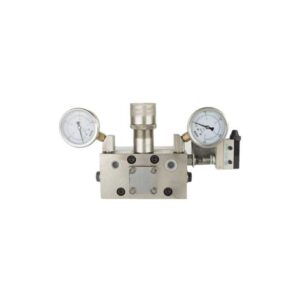
What the PF-200 Does
The PF-200 is an air-assisted grease spray valve. Each cycle it meters a dose of 0.5-2.0 cm3 and atomizes it with shop air onto open machinery surfaces: girth gears, swing bearings, chains, wire ropes, and slides. It exists because those parts have no fitting, so there is nowhere for a grease gun coupler or a divider outlet to attach. Where fitting-based lubrication ends, surface spraying begins, and the automatic lubrication hub shows where this valve sits in a full system.
Declared Specifications
| Item | Specification |
|---|---|
| Maximum grease pressure | 10 MPa (100 bar / 1,450 PSI) |
| Atomizing air | 0.5 MPa minimum; 0.6-0.8 MPa optimal |
| Output per cycle | 0.5-2.0 cm3, set by the metering screw |
| Cycle time | 0.3-1.5 s |
| Maximum flow | 120 cm3/min at 10 MPa |
| Spray distance | 200 mm nominal |
| Coverage diameter | 120 mm |
| Grease inlet | G1/4 or M10x1 |
| Air connection | 6 mm push-fit or 1/4 NPT |
| Supply tubing | 6 or 8 mm OD |
| Temperature | -20°C to +80°C with NBR; PF-200-HT with FKM -40°C to +120°C |
| Body | Anodized aluminum 6061-T6; nozzle hardened stainless |
| Seals | NBR standard, FKM optional |
| Weight | 0.8 kg |
| Mounting | Bracket with 2x M8 fasteners |
How Air-Assisted Spraying Works
One cycle is two events. The solenoid pulses, the metering screw displaces a set dose of grease, and atomizing air immediately shatters the dose into a spray: one pulse equals one metered cycle. After the dose, an after-blow of air continues briefly and clears the nozzle so grease cannot linger and string. The metering screw sets the dose, while air pressure and cycle duration shape how the spray lands. Stay within the declared pressure-flow behavior: at 2, 4, 6, 8, and 10 MPa supply, flow runs about 40, 65, 90, 110, and 120 cm3/min and the spray reaches about 160, 180, 195, 205, and 215 mm.
Mounting and Spray Geometry
The declared geometry is simple: mount the valve about 200 mm from the surface, nozzle down, and it lays down a coverage diameter of about 120 mm. Vertical nozzle-down mounting is preferred even though the valve can function horizontally, because gravity helps the after-blow clear the nozzle. The bracket takes 2x M8 fasteners, and at 0.8 kg the valve places little load on nearby structures. Aim at the mesh or wrap zone, not at empty space beside it.
Grease Grades and Supply Conditions
The valve handles NLGI 00 to 2 with base oil viscosity class 100-460, including EP greases and solid additives such as graphite or MoS2. NLGI 2 is the boundary case: it needs supply pressure above 4 MPa and ambient above 15°C, and NLGI 3 clogs, so do not attempt it. Feed the valve from a high-pressure grease pump that holds pressure between pulses. Confirm the grease grade for your equipment, and remember that cold weather changes pumpability more than the grade alone suggests.
Variants and Spares
Three variants cover harsher duty. PF-200-HT swaps NBR for FKM seals and widens the range to -40°C to +120°C. PF-200-SS is full stainless for corrosive service. PF-200-EX exists for sites that need it, but suitability for your site must be confirmed before ordering, so do not assume. Spares are straightforward: the PF-200-SK seal kit, the PF-200-NZ nozzle, the PF-200-AIR solenoid in 24V DC, 110V AC, or 230V AC, and the PF-200-BR bracket. Rebuild seals when the dose drifts or the spray weakens, and verify the dose every 6 months: it should stay within a tenth of the setting. In a central layout, progressive metering blocks handle the points that do have fittings, and a central lubrication system can drive both sides from one pump; the grease pump hub covers the supply options.
Unsure which variant fits your site conditions? Describe the application through our contact page.
Frequently Asked Questions
What is the PF-200 and when is it used?
It sprays a metered grease dose onto surfaces like open gears, chains, and wire ropes. Use it where no fitting exists for a grease gun coupler.
Which grease grades work?
NLGI 00 to 2 suit the valve. NLGI 2 needs above 4 MPa supply and above 15°C, and NLGI 3 clogs.
Why is the spray weak or fading?
Low supply pressure, air-line moisture, or a worn nozzle are the usual causes. Check all three before adjusting the metering screw.
Why does it drip after cycles?
Mount the valve vertical with the nozzle down. Then adjust air pressure and cycle duration.
What air supply does it need?
Each valve needs only a small air flow, but a moisture separator matters. Provide 0.6 to 0.8 MPa atomizing air.
Spray or point lubrication?
Spray covers open surfaces with no fitting to couple to. Point lubrication suits bearings with coupler-accessible fittings.
Can it connect to a central system?
Yes. The supply pump holds grease pressure while a controller pulses the solenoid for each cycle.
Can it mount horizontally?
It functions horizontally, but vertical nozzle-down mounting is preferred. Gravity helps the after-blow clear the nozzle.
Who can confirm the right variant?
Ask about variant selection through our contact page. Describe the temperature, atmosphere, and duty cycle.
Who builds and supports these valves?
IsoHiTech Lubrication Systems, founded in 2023, engineering since 2006, builds and supports every unit. Email inquiry@isohitech.com for specifications and a quotation.