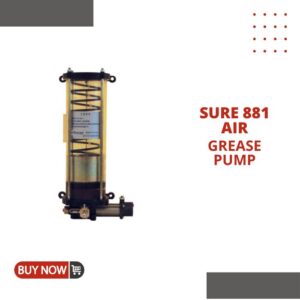
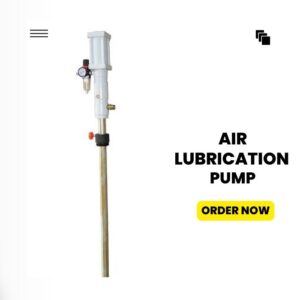
Aftermarket SM SUREMATIC Air Grease Pump
This page describes an aftermarket air-operated grease pump that cross-references the Bijur Delimon SM SUREMATIC. Bijur Delimon and SUREMATIC are trademarks of their respective owner. This is an aftermarket pump, not manufactured, sponsored, or endorsed by Bijur Delimon. SM designations are for cross-reference identification only.
The pump is a compressed air-driven piston unit for PDI centralized grease systems, configured as SM-PDI. It operates in discrete cycles, not continuous running, with a single action piston driven forward by air and returned by spring.
How the SM-PDI Cycle Works
A two-position solenoid valve on the air inlet is controlled by a PLC or timer. When air is on, one complete piston stroke delivers a fixed 8 ml dose into the PDI circuit. When air is off, the spring returns the piston to the start position. The PDI injectors meter the dose to each lubrication point. The interval between cycles is set by the controller, while the dose is set by the pump stroke.
Specifications
| Discharge per cycle | 8 ml fixed |
| Pressure ratio | 18:1 |
| Air input | 0.28-1.05 MPa adjustable |
| Grease output pressure | about 5-19 MPa (air input x 18:1 ratio) |
| Max cycle frequency | 5 cycles/min |
| Grease | NLGI 000-2 |
| Level switch contact rating | 125 VAC 6 A or 250 VAC 3 A |
| Part numbers | 28811 (0.8 L), 28812 (2.0 L), 28813 (3.5 L), 41684 (5.0 L) |
Reservoir Sizes
All four part numbers share identical pump performance. Only the reservoir size differs. The 0.8 L unit suits compact or low consumption applications. The 2.0 L is the standard size for many PDI circuits. The 3.5 L covers medium to high consumption points. The 5.0 L supports high consumption or long refill intervals. To estimate refill interval, multiply cycles per day by 8 ml and compare to reservoir capacity.
PDI System Behavior
In a PDI system the injectors charge and then vent lubricant to each point. The pump dose feeds the injector network during each air-on stroke. If an injector or line becomes blocked, system pressure rises while the pump still tries to deliver its dose. Before replacing the pump, check injectors and lines for blockage. For more detail read about single-line lubrication system and what is a central lubrication system.
What to Confirm Before Ordering
Confirm the reservoir size and part number, air supply pressure range, whether the solenoid valve is included and its voltage, and whether the level switch is included. Review the options for your grease pump installation and contact the team if the part number is not clear.
Frequently Asked Questions
Is 8 ml per pump cycle or per injector?
The 8 ml dose is per pump cycle. Injectors meter that dose to each point.
Can the dose be changed?
The stroke is fixed at 8 ml. The interval is set by the controller.
Which reservoir should I choose?
Match reservoir size to daily consumption. Estimate use from cycles per day.
What air pressure does this pump need?
Air input range is 0.28-1.05 MPa. Output pressure scales at an 18:1 ratio.
Is the solenoid valve included?
Solenoid valve inclusion varies by configuration. Confirm inclusion and voltage before ordering.
Can it replace a continuous pump?
It is not a continuous running pump. Confirm your control system supports discrete cycles.
Is NLGI 2 grease OK?
Yes, the pump handles NLGI 000-2. Use grease within that range.
What if an injector blocks?
System pressure rises when a point blocks. Isolate and check before replacing the pump.
What controllers work with this pump?
A PLC or timer can drive the solenoid. The controller only sets the cycle interval.
Who builds this pump, and how do I get a quotation?
IsoHiTech Lubrication Systems, founded in 2023, engineering since 2006, builds and supports every unit. Email inquiry@isohitech.com for specifications and a quotation.
Contact the team with your part number.