What brass swivel connectors do
A brass swivel connector joins two threaded ends while letting one side rotate around the other. The rotation relieves torsion in the hose, so the hose follows the tool or equipment instead of fighting it. That prevents kinking, twist damage, and early failures at the coupling. These connectors sit wherever a lubrication, air, or hydraulic line bends or moves: reel hoses, hand tools, machine pivots, dispense points. A grease hose under daily handling is a typical place to fit one. Unlike a rigid compression tube fitting, a swivel lets the line turn.
Threads, sizes, and options
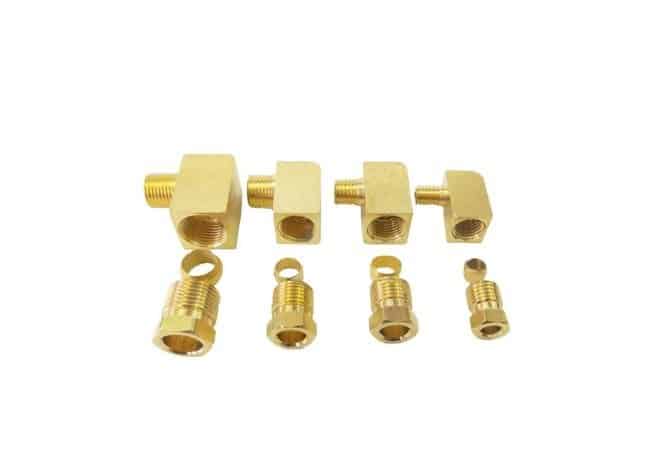
Bodies are solid brass in the C360 free-machining grade, natural or nickel-plated, with a sintered bronze bushing or sealed ball bearing inside. The thread range covers tapered and parallel forms in inch and metric sizes.
| Thread form | Style | Sizes offered |
|---|---|---|
| NPT | Tapered | 1/8 inch up to 1 inch |
| BSPT | Tapered | 1/8 inch up to three-quarter inch |
| M8x1 | Parallel metric | 8 mm x 1 mm |
| M10x1 | Parallel metric | 10 mm x 1 mm |
| M12x1.5 | Parallel metric | 12 mm x 1.5 mm |
| M14x1.5 | Parallel metric | 14 mm x 1.5 mm |
Finishes run from natural brass to nickel-plated and chrome-plated; nickel plating is a surface finish and does not change the pressure rating. As our grease fitting types guide puts it: identify the thread system first, then the size.
Pressure and temperature by application
A swivel is rated as a system of body, bearing, seals, and threads. The figures below are per application; the working rating of the finished joint is set by its weakest component.
| Application | Pressure | Temperature | Seal |
|---|---|---|---|
| Air and pneumatics | 250 PSI (17 bar) | -35°C to +80°C | NBR |
| Industrial water | 600 PSI (41 bar) | By installation | By installation |
| Hydraulic | 1500 PSI (103 bar) | -35°C to +100°C | NBR |
| Lubrication systems | 1160 PSI (80 bar) | By seal choice | NBR, EPDM, or FKM |
If working pressure exceeds the declared figure, confirm the joint with us before ordering.
Inline, elbow, or ball-socket
Three families cover most routing problems. An inline swivel gives full 360° rotation. An elbow has a fixed 90° bend with the swivel at the outlet, the same job as the 90-degree swivel joint for air and grease pump lines on pump outlets. A ball/socket design accepts up to 15-25 degrees of deflection for ports that get re-aimed.
| Design | Movement | Best for |
|---|---|---|
| Inline swivel | 360° rotation | Straight runs that twist during use |
| Elbow swivel | 90° bend, swivel at the outlet | Tight corners and panel clearance |
| Ball/socket | Multi-axis, 15-25 degrees deflection | Ports that need frequent re-aiming |
All three relieve torsion; none is built for continuous rotation under load. A rotary joint built for continuous rotation suits hoses that must spin with the equipment.
Choosing the seal material
NBR, the standard seal, suits petroleum oils and general grease within the -35°C to +80°C air range. EPDM fits hot water and steam service but is not compatible with petroleum oils. FKM covers synthetic fluids and phosphate esters up to +200°C. NBR suffers in ketones, so check the exact fluid before ordering. For a connector matched to your fluid, thread, and pressure, contact us for a quote.
Installing without damaging the swivel
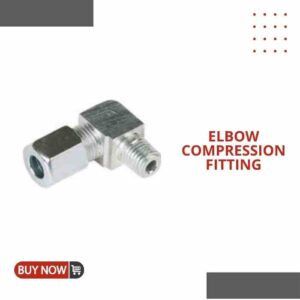
Tapered threads (NPT, BSPT) seal on the flanks: apply 2-3 wraps of PTFE tape, keeping it off the first threads. Parallel threads seal at the face with a bonded washer or O-ring. Go hand-tight, then 1-2 wrench turns; over-torque loads the internal bearing instead of improving the seal. For rigid tube corners, use an elbow compression fitting. After assembly, pressurize to working pressure and check every joint.
Frequently Asked Questions
What does a brass swivel connector do?
It joins two threaded ends while letting one side rotate, keeping the joint sealed. The rotation relieves torsion in the hose and prevents kinking and twist damage at the joint.
Inline, elbow, or ball-socket: which design should I pick?
Inline gives full 360° rotation for straight runs, and elbow gives a fixed 90° bend with swivel at the outlet. Ball/socket gives multi-axis deflection up to 15-25 degrees for ports that get re-aimed often.
What is the difference between a swivel and a rotary joint?
A swivel relieves torsion and allows positioning rotation. A rotary joint is built for continuous rotation, with its own speed, torque, and sealing behaviour.
Is a ball swivel the same as a ball-check nipple?
A ball swivel and a ball-check nipple only share the word ball. In a swivel the ball is a bearing element; in a grease nipple it is a spring-loaded check valve.
Which thread types are available?
Inch threads are NPT tapered from 1/8 inch to 1 inch and BSPT tapered from 1/8 inch to three-quarter inch. Metric threads are M8x1, M10x1, M12x1.5, and M14x1.5.
How do pressure and temperature ratings depend on the seal?
The air row covers -35°C to +80°C at 250 PSI (17 bar) with NBR seals. The hydraulic row covers -35°C to +100°C at 1500 PSI (103 bar) with NBR.
How do I install a swivel without leaks?
Tapered threads take 2-3 wraps of PTFE tape; parallel threads seal at the face with a bonded washer or O-ring. Go hand-tight, then 1-2 wrench turns.
Can I use these swivels with hydraulic or synthetic fluids?
Mineral hydraulic oil fits the declared hydraulic row with NBR seals. Synthetic fluids and phosphate esters need FKM seals instead.
What about marine or corrosive environments?
Nickel-plated or chrome-plated brass protects the surface better than natural brass. For stainless options, contact us for a quote describing your exposure.
Who makes these swivel connectors?
IsoHiTech Lubrication Systems, founded in 2023, engineering since 2006, builds and supports every unit. Email inquiry@isohitech.com for specifications and a quotation.