ZP-A Small-Dose Metering, Outlet by Outlet
The ZP-A is the small-dose distributor in the JPQ1-K family, metering 0.07, 0.1, 0.2, or 0.3 ml/stroke at every outlet for points that need only a little grease or oil per cycle. When each point needs only a small, exact dose, start here; for doses of 0.5 ml/stroke and up, start at the JPQ progressive block family page.
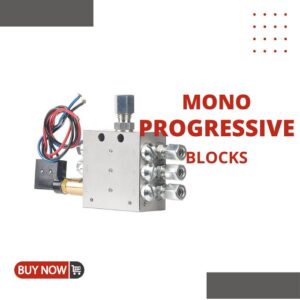
This page stays on one series. For a fixed-outlet mono block, see the mono progressive block page; for the pump and main line around it, see the central lubrication system guide.
What “0.07-0.3 ml/stroke” Means Here
Metering is counted per outlet and per full cycle; one cycle means every piston has moved once in order and every outlet has discharged its fixed volume once. With the 0.1 ml/stroke setting, one bearing point receives 0.1 ml per cycle, and over an interval 0.1 ml/stroke x 30 cycles = 3 ml to that point (0.1 x 30 = 3 ml).
That small total is the point. Over-greasing a small bearing heats it and pushes grease past the seals; under-greasing wears it. A fixed small dose avoids the flooding a large block would cause at the same cycle count. Typical fits are small bearings, precision assemblies, machine tool spindles, and textile machinery.
Honest Limits of the ZP-A
First, temperature: the indicator version runs from -20°C to +80°C; the non-indicator version is rated up to +110°C, and switching versions changes the assembly, so confirm it when ordering. Second, pressure: up to 160 bar (16 MPa) is supported, but the pressure gap between any two outlets must stay within 50 bar, or the piston sequence can stall and stop metering. Third, lubricant: oil at 68 to 1,500 cSt, fluid grease, and grease to NLGI 3 are supported; harder grease will not meter through the small bores. If your setup sits near one of these edges, confirm this configuration before ordering.
ZP-A Specifications
| Parameter | Value |
|---|---|
| Metering per outlet per cycle | 0.07 / 0.1 / 0.2 / 0.3 ml/stroke |
| Outlets | 6 – 24 |
| Flow range | 0.5 – 1000 cm3/min |
| Max working pressure | Up to 160 bar (16 MPa) |
| Working temperature | -20°C to +80°C with indicator; up to +110°C without indicator |
| Lubricants | Oil 68 to 1,500 cSt; fluid grease; grease to NLGI 3 |
| Inlet thread | G 1/8, for 10 mm tubing |
| Outlet thread | G 1/8, for 6 mm tubing |
| Max differential pressure between outlets | 50 bar |
| Weight | 1.03 kg at 6 outlets to 4.11 kg at 24 outlets |
| Construction | Inlet section, intermediate sections, and end section; the section count sets the outlet count |
Frequently Asked Questions
Should I pick the ZP-A when each point needs only a tiny dose?
Pick the ZP-A when the dose per point falls in the 0.07-0.3 ml/stroke band, especially for small bearings or precision points where extra grease does harm. For 0.5 ml/stroke or more, or the whole family side by side, use the JPQ progressive block family page. For a fixed-outlet mono block, use the mono progressive block page.
What does 0.07-0.3 ml/stroke mean in practice?
It is the fixed volume each outlet discharges in one full cycle, counted per outlet rather than for the whole block: a 12-outlet assembly on the 0.1 ml/stroke setting gives each of its 12 points 0.1 ml per cycle, not 0.1 ml shared among them.
How does such a small dose prevent bearing over-lubrication?
The dose per cycle is fixed, so what a bearing receives over an interval is the dose times the cycle count, and you control the count at the pump or timer. This suits bearings that commonly run hot or throw grease when fed large doses.
How does the three-section structure set the outlet count?
The assembly has an inlet section, intermediate sections, and an end section. The inlet takes the main line, each intermediate section carries the metering pistons and their outlets, and the end section closes the assembly. The section count sets the outlet count: order the block for the point count the machine has today, and confirm the section-to-outlet arrangement for your configuration when ordering.
Can I add inlet, intermediate, or end sections on site?
Intermediate sections can be added, but not by bolting one on: the pistons must fire in order, so new sections need re-piping and air bleeding, and the outlet count must match the machine again. Plan the section count with the layout, not as a field fix.
What does the indicator pin tell me?
The pin moves when the monitored piston completes its cycle. It confirms that this section cycled, not that grease exited at every downstream point; a blocked line stops the pin, which is what it is there to flag.
What does the up to +110°C version leave out?
The non-indicator version drops the visible pin and its internal parts, which allows the higher temperature rating. If you need both the high limit and visual indication, that mix is not offered, so weigh it when you pick the version.
How do the G 1/8 inlet and outlet threads connect to tubing?
The inlet thread is G 1/8, taking the main line through 10 mm tubing. Each outlet thread is also G 1/8 and feeds its point through 6 mm tubing. Threads match, but tubing differs, so confirm fitting sizes to stock.
How does the weight change with the outlet count?
Weight grows with the sections: 1.03 kg at 6 outlets and 4.11 kg at 24 outlets, since each added intermediate section adds outlets and mass.
Who is IsoHiTech and how do I confirm my configuration?
IsoHiTech Lubrication Systems, founded in 2023, engineering since 2006, supplies progressive distributors and related parts. To confirm the metering setting, outlet count, indicator version, and tubing fit, get a quote or write to inquiry@isohitech.com.