


Disclaimer: Performance and service-life figures in this guide are illustrative and application-dependent; actual results vary by equipment, operating conditions, and maintenance practices. Brand names such as Lincoln, SKF, Graco, Bijur, Dropsa, Alemite, LockNLube, Cenlub, and Trico are used for compatibility and identification only. IsoHiTech is an independent supplier of lubrication components and is not an independent supplier for those brands.
Grease distributor blocks distribute lubricant from a central pump to multiple lubrication points in machinery. This guide explains the working principle of grease distributor blocks, their typical benefits, common applications, and selection criteria for industrial equipment.
For a comparison between lubrication distribution systems, see the progressive vs single-line grease distribution analysis.
Overview of grease distributor block
This technical guide is intended for maintenance engineers, plant managers, and equipment specifiers reviewing grease distributor block technology. It covers selection criteria based on international standards, operational principles, and maintenance protocols. Operator reports and industry estimates indicate potential improvements in many applications, including reduced grease consumption, extended bearing service life, and payback commonly reported within 12–24 months; actual results depend on operating conditions.
Contents
- The Grease Distributor Working Principle with Benefits and Applications
- Technical Standards and Industry Compliance
- The Working Principle of Grease Distributor Block
- Different Types of Grease Distributor Blocks
- Key Features Of The Grease Blocks
- Functions Of The Grease Blocks
- Maintenance Of The Grease Blocks
- Applications Of The Grease Blocks
- Selection Criteria and Standards
- Safety and Compliance Considerations
- Performance and Service Life
- Related Technical Resources
- People Also Ask
- FAQ
The Grease Distributor Working Principle with Benefits and Applications
Using a grease distributor can offer several benefits for industrial lubrication applications:
- Consistent lubricant delivery: Grease distributors supply a controlled amount of lubricant to each point, helping ensure that components receive appropriate lubrication without excessive waste.
- Reduced maintenance demand: Proper lubrication can reduce wear on moving parts, which may lower the need for repairs in some applications.
- Extended equipment service life: Consistent lubrication can reduce friction and wear, contributing to longer component life under suitable conditions.
- Improved working conditions: Controlled delivery reduces over-lubrication and spillage hazards, and reduces the need for personnel to reach remote lubrication points.
- Time savings: Automated lubrication systems can reduce manual lubrication tasks, allowing maintenance resources to be allocated elsewhere. Overall, a grease distributor can support more consistent machinery operation, lower lubricant waste, and reduced maintenance demand in many installations.
For more information on centralized lubrication systems, see the complete lubrication systems guide.
Quantified Performance Benefits
Field reports and industry studies indicate potential improvements; individual results vary by application:
- Grease consumption reduction: Operators have reported decreases of 30–50% in some applications compared with manual lubrication methods.
- Bearing service life: Some applications report bearing life extension of 3–5 times through consistent lubrication delivery.
- Maintenance labor: Operator reports indicate up to 80% reduction in routine lubrication tasks in some installations.
- Unplanned downtime: Some installations report up to 85% reduction in lubrication-related equipment failures.
- Return on investment: Payback is commonly reported within 12–24 months in industrial applications, depending on utilization and maintenance baseline.
Technical Standards and Industry Compliance
International Standards and Certifications
ISO Standards:
- ISO 12241:2008 – Lubrication systems — Centralized lubrication systems — General requirements
- ISO 15136-1:2009 – Petroleum and natural gas industries — Progressing cavity pump systems for artificial lift
- ISO 281:2007 – Rolling bearings — Dynamic load ratings and rating life
DIN Standards:
- DIN 3384 – Progressive distributors for centralized lubrication systems
- DIN 24318 – Lubrication systems — Progressive distributors — Dimensions and requirements
- DIN 51825 – Lubricants — Testing and classification system for lubricating greases
Leading Manufacturer Compliance:
- SKF Lincoln: QUBE systems are reported to meet aerospace AS9100 standards.
- Bijur Delimon: Products are reported to comply with the ATEX directive for explosive atmosphere applications.
- BEKA: Products are reported to carry CE marking and FDA compliance for food-grade applications.
- Groeneveld: Products are reported to carry IP65/IP67 environmental protection ratings.
Understanding and applying these technical standards is important for system selection. The grease distributor block selection guide explains how to design and select systems according to these standards.
The Working Principle of Grease Distributor Block

This video shows the working situation of the grease distributor. Because grease is more viscous than oil, these systems use pistons to push it out one by one. In the complete system, one piston is positioned on the opposite side compared to the rest of the pistons.
After understanding the working principle, proper system installation is important for reliable performance. The grease distributor block installation guide provides installation procedures and commissioning requirements.
Advanced Technical Mechanisms
Thixotropic Behavior Management:
Grease exhibits thixotropic properties where apparent viscosity decreases under mechanical stress. Progressive distributor blocks apply controlled shear forces during distribution, temporarily reducing grease viscosity for improved flow while maintaining structural integrity at rest.
Pressure Wave Dynamics:
Sequential piston operation creates controlled pressure waves that help evacuate grease from distribution lines. This positive displacement principle can reduce dead zones common in flow-based oil systems, helping ensure that each lubrication point receives fresh grease.
Temperature Compensation:
Modern progressive blocks incorporate thermal expansion compensation through precision-machined clearances, temperature-stable sealing materials (Viton/FKM rated -40°C to +200°C), and viscosity-compensated piston designs for consistent operation across temperature ranges.
Different Types of Grease Distributor Blocks
Selecting the appropriate type of grease distributor block for a given application is important to help ensure reliable performance and service life. Several key factors should be considered during selection:
Proper selection requires considering multiple technical parameters. The grease distributor block selection guide provides calculation methods and selection criteria.
For a detailed comparison between Progressive, Single-Line, and Dual-Line systems, refer to the system type comparison analysis.
- The size of the lube points: for very large lube points, a higher discharge volume is typically chosen.
- The application: for cement or steel industry applications, dual-line blocks are typically chosen. For common industrial applications, progressive blocks are typically used. For vehicle chassis lubrication, IHI smart blocks are commonly used.
Technical Specifications Comparison Table
| System Type | Pressure Range | Outlets | Volume/Cycle | Monitoring | Typical Applications | Reported Standards Compliance |
|---|---|---|---|---|---|---|
| Single-Line | 50-400 bar | 1-12 | 0.1-2.0 ml | Manual indicators | Light machinery, conveyors | DIN 24318 |
| Progressive | 100-500 bar | 2-16 | 0.03-5.0 ml | Sequence monitoring | Manufacturing, CNC equipment | ISO 12241, SKF certified |
| Dual-Line | 200-700 bar | 6-50+ | 0.2-20.0 ml | Electronic optional | Heavy industry, mining | NACE compliant |
Types Of Grease Blocks
Single-Line Blocks:
Used in single-line lubrication systems. Distribute a predetermined amount of grease to each lubrication point when the pump is activated.
Dual-Line Blocks:
Used in dual-line lubrication systems. Have two inlet ports and can serve a larger number of lubrication points.
Progressive Blocks:
Used in progressive lubrication systems. Consist of a series of metering pistons that dispense grease in a sequential manner to various lubrication points.

DJF1000 Grease Blocks

DJF2000 Grease Blocks

DJF3000 Grease Blocks

DJF2500 Grease Blocks

SSVB Grease Blocks

IHI Grease Blocks
View IsoHiTech progressive distributor blocks
Advanced Feature Analysis
Progressive Systems (DJF2000, Lincoln QuickLub):
- Self-monitoring capability through indicator pin sequencing
- Precision metering; manufacturer specifications may cite ±2% accuracy on discharge volumes
- Modular design allowing field expansion
- Industry 4.0 monitoring system compatibility
Dual-Line Systems (DJF2500, SKF MonoFlex):
- High-pressure capability rated up to 700 bar in manufacturer literature
- Large capacity serving 50+ lubrication points from a single block
- Robust construction designed for continuous operation in harsh environments
- Parallel operation capability for multiple simultaneous blocks
For detailed information about various lubrication system types, explore the comprehensive guide to different types of lubrication systems.
Key Features Of The Grease Blocks
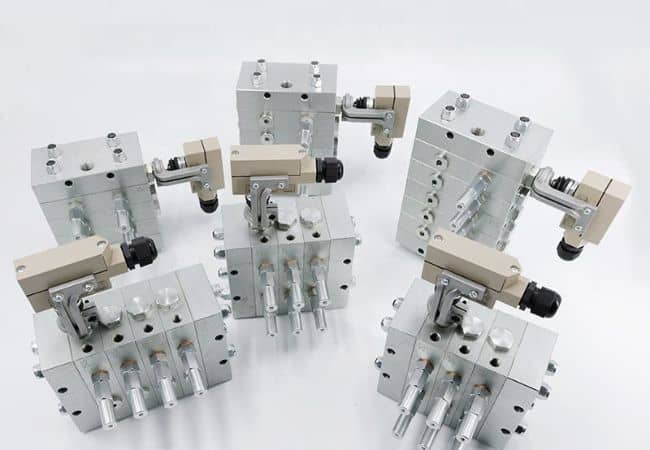

Material:
Often made of high-quality materials to withstand harsh operating conditions and corrosive lubricants.
Adjustability:
Some grease blocks allow adjustment of the amount of grease delivered to each point.
Indicator Pins:
Often equipped with visual indicators to confirm that grease has been delivered to each point.

Catalogue Download
Advanced Material Engineering
Precision Manufacturing Standards:
- Surface finish: Ra 0.8μm on critical sealing surfaces
- Dimensional tolerance: ±0.02mm on piston diameters
- Material traceability: Complete mill certificates for critical components
- Quality assurance: pressure testing to 1.5× working pressure
Advanced Seal Technology:
- Multi-lip seals preventing contamination ingress while maintaining low friction
- Spring-loaded designs compensating for wear and thermal expansion
- Material compatibility with chemical resistance charts for 200+ lubricant types
- Service life typically 24-36 months under normal operating conditions
How Are the Balls Pressed?
https://vimeo.com/860865594?share=copy
This video shows the steel-ball pressing process used in these components. The seals are designed for reliable operation.
Functions Of The Grease Blocks
Distribution:
Grease blocks distribute the lubricant to multiple points, helping ensure that each point receives the appropriate amount of lubricant at the required time.
Monitoring:
Some advanced grease blocks can be monitored electronically to help ensure proper lubrication and to alert operators of any issues.
Flexibility:
They can be configured to serve a varying number of lubrication points, making them adaptable to different machinery and equipment sizes.
Maintenance Of The Grease Blocks
Inspection:
Regular inspection is necessary to help ensure that the grease blocks are functioning properly and are not clogged.
Cleaning:
Periodic cleaning removes old grease and debris to help maintain reliable performance.
Replacement:
Worn or damaged grease blocks should be replaced to maintain the efficiency of the lubrication system.
Systematic maintenance strategies are essential for equipment reliability. Preventive maintenance includes detailed schedules and inspection checklists.
When systems show abnormal behavior, quick and accurate fault diagnosis is critical. Refer to the grease distributor troubleshooting guide for diagnostic methods and solutions.
Advanced Maintenance Protocols
Step-by-Step Troubleshooting Protocol:
Initial Assessment (5 minutes):
Visual Check → Indicator Pins Extended?
 Yes → Check Pressure Gauge Reading
 No → Proceed to Pressure System Check
Pressure System Analysis (15 minutes):
System Pressure Normal?
 Yes → Individual Outlet Testing Required
 No → Check Pump, Relief Valve, Main Lines
Individual Outlet Testing (30 minutes):
Disconnect Outlet Lines → Manual Cycle Test
 Grease Flows → Check Distribution Line for Blockage
 No Flow → Internal Block Service Required
Preventive Replacement Schedule:
| Component | Replacement Interval | Key Indicators |
|---|---|---|
| Indicator pins | 24 months | Sluggish movement, corrosion |
| Main seals | 18 months | Pressure loss, external leakage |
| Pistons | 60 months | Volume inconsistency, wear marks |
| Complete block | 120 months | Housing wear, obsolescence |
Applications Of The Grease Blocks
Different industrial sectors have specific technical requirements for lubrication distribution systems:
Steel Industry: High-temperature environments and heavy-duty operations require special designs. See the steel industry lubrication systems guide for technical features.
Mining Equipment: System reliability in extreme environments is the core requirement. See mining equipment lubrication solutions for design considerations.
Food Processing: FDA compliance and hygienic design are essential requirements. Food-grade grease distribution systems should comply with applicable sanitary standards.


Industrial Equipment:
Used in various industrial machines to help ensure proper lubrication of moving parts.
Heavy Machinery:
Common in construction and mining equipment to reduce wear.
Automotive:
Used in some automotive applications for centralized lubrication.
Industry-Specific Case Studies
Steel Mill Rolling Stand Application:
- Challenge: Manual lubrication of 48 bearing points causing inconsistent application and 15% unplanned downtime
- Solution: DJF3000 progressive blocks with high-temperature seals and electronic monitoring
- Results: Operator-reported 87% reduction in lubrication-related failures, 40% decrease in grease consumption, and ROI achieved in 14 months
Food Processing Conveyor System:
- Challenge: FDA compliance requirements and frequent washdown procedures
- Solution: SSVB series with 316SS construction and IP69K rating
- Results: Operator-reported full compliance with applicable sanitary standards, 60% reduction in bearing replacements, and zero contamination incidents over a 2-year period
Wind Turbine Pitch System:
- Challenge: Remote location access and extreme weather conditions (-40°C to +60°C)
- Solution: IHI smart blocks with IoT connectivity and predictive analytics
- Results: Operator-reported 95% reduction in maintenance site visits, with predictive maintenance reportedly preventing 23 potential failures annually
Learn more about automatic lubrication systems and their applications across various industries.
Selection Criteria and Standards
Engineering Selection Matrix
Primary Selection Factors:
- Flow Rate Requirements (per ISO 12241):
- Calculate total system consumption: Σ(point requirement × cycle frequency)
- Apply safety factor: 1.2-1.5× calculated consumption
- Consider grease type viscosity effects at operating temperature
- Pressure Rating Selection (per DIN 24318):
- System pressure + line losses + 20% safety margin
- Consider altitude effects: -3% per 1000m elevation
- Temperature compensation: +10% for high-temperature applications
- Environmental Compatibility:
- Operating temperature range
- Chemical exposure resistance
- Contamination level protection requirements
- Vibration and shock resistance specifications
Application-Specific Selection Guidelines
Manufacturing Equipment (SKF Guidelines):
- Machine Tools: Progressive blocks with 0.1-0.5ml discharge volumes
- Packaging Lines: Single-line systems with food-grade certification
- Assembly Robots: Smart blocks with cycle-synchronization capability
Heavy Industry (BEKA/Lincoln Standards):
- Steel Mills: Dual-line systems rated for 600+ bar, high-temperature seals
- Cement Plants: Progressive blocks with dust protection (IP65+ rating)
- Power Generation: Grease blocks with nuclear qualification where applicable
For specific product information, visit the DJF1000 progressive distributor blocks page to explore compact solutions for light to medium-duty applications.
Safety and Compliance Considerations
High-Pressure Grease Handling Safety
Personal Protective Equipment Requirements:
- Safety glasses with side shields (ANSI Z87.1)
- Cut-resistant gloves (Level 3 minimum)
- Steel-toed safety shoes
- Hearing protection in pump areas (>85 dB)
Lockout/Tagout Procedures:
- System Isolation: De-energize pump motor and engage lockout device
- Pressure Relief: Open relief valve and verify zero pressure on gauge
- Verification: Attempt system start to confirm energy isolation
- Tag Application: Apply personal LOTO tags per OSHA 1910.147
Regulatory Compliance by Industry
Food Processing (FDA/USDA/3A Standards):
- Materials: 316/316L stainless steel construction required
- Lubricants: NSF H1 registered food-grade greases exclusively
- Design: Hygienic design principles, eliminating dead legs or contamination traps
- Documentation: Maintain lubricant MSDS and application logs
Hazardous Locations (OSHA/NFPA 497):
- Electrical: Intrinsically safe or explosion-proof equipment
- Grounding: Proper bonding and grounding of all metallic components
- Hot work: Permits required for welding or cutting operations
- Ventilation: Adequate ventilation preventing vapor accumulation
Performance and Service Life
Cost-Benefit Analysis Framework
Initial Investment Calculation:
- Equipment cost: Progressive blocks vs. manual lubrication equipment
- Installation cost: Professional installation and commissioning
- Training cost: Operator and maintenance personnel education
- Infrastructure cost: Distribution lines, fittings, and controls
Operational Savings Quantification:
- Labor reduction: (Current hours × hourly rate) × efficiency improvement %
- Grease savings: (Current consumption × cost/kg) × reduction %
- Downtime prevention: (Failure frequency × downtime cost) × improvement %
- Component life extension: (Replacement cost ÷ original life) × life extension factor
Key Performance Indicators
Operational Excellence Metrics:
- System availability: >99.5% uptime target in well-maintained installations
- Lubrication point coverage: target of 100% scheduled deliveries
- Grease consumption efficiency: <5% variance from calculated requirements
- Predictive maintenance accuracy: >90% fault prediction rate reported in advanced implementations
Related Technical Resources
To help master grease distribution system technology, the following technical guides are available:
Core Technical Guides:
- Grease Distribution System Type Comparison – In-depth analysis of three main system types
- Grease Distributor Block Selection Guide – Selection methods and standards
- Installation Technical Guide – Installation points for system performance
Maintenance and Troubleshooting:
- Preventive Maintenance Guide – Maintenance strategies to extend equipment life
- Professional Troubleshooting Guide – Quick diagnosis and resolution of common problems
Industry-Specific Solutions:
- Steel Industry Lubrication Systems – Solutions for high-temperature heavy-duty conditions
- Mining Equipment Lubrication Solutions – Reliability designs for extreme environments
- Food-Grade Lubrication Systems – Hygienic designs meeting FDA standards
People Also Ask
What is the working principle of a grease distributor block?
A grease distributor block receives pressurized grease from a pump and routes it through internal passages and metering pistons to deliver a controlled volume to each lubrication point. Progressive blocks use sequential piston operation; if one outlet fails, the sequence stops and the blockage can be detected. See the working principle section above for details.
What are the types of grease distributor blocks?
The main types are single-line, dual-line, and progressive distributor blocks. Single-line blocks suit light machinery, progressive blocks are common in manufacturing and CNC equipment, and dual-line blocks are used in heavy industry and mining. A comparison table is provided in the types section.
How are grease distributor blocks selected?
Selection should be based on total flow requirement, system pressure, number of lubrication points, operating temperature, environmental exposure, and applicable standards such as ISO 12241 and DIN 24318. The selection criteria section outlines the engineering selection matrix.
What materials are used in grease distributor blocks?
Grease distributor blocks are typically made from carbon steel, stainless steel, or engineered alloys, with seals in nitrile, Viton/FKM, or other materials selected for operating temperature and lubricant compatibility. Material details are covered in the key features section.
How often should grease distributor blocks be maintained?
Maintenance intervals depend on duty cycle and environment. Typical preventive replacement schedules suggest inspecting indicator pins every 24 months, main seals every 18 months, pistons every 60 months, and complete blocks every 120 months. See the maintenance section for the full schedule.
grease distributor block FAQ
How does a grease distributor work?
A grease distributor, such as a progressive block, delivers grease to lubrication points by pumping grease through interconnected passages and metering valves. This can help machinery operate with less wear and lower maintenance demand.
What is a grease centralized dispensing system?
A centralized grease dispensing system delivers lubricant to multiple points from a central source. Progressive blocks can provide a measured amount to each point, which may reduce waste and support consistent lubrication across the operation.
What is a grease block?
A grease block is a component of a central lubrication system that distributes lubricant from the pump to various points, helping each receive an appropriate amount to reduce friction and wear.
How are grease blocks maintained?
Regular inspection and cleaning are necessary. Maintenance personnel should check for blockages, leaks, or wear, clean old grease and debris, and replace worn components as needed.
How is grease block operation verified?
Many grease blocks include visual indicators or pins to confirm lubricant delivery. Advanced systems may include electronic monitoring to alert operators to issues.
Can grease block output volume be adjusted?
Many grease blocks allow adjustment of metering valves to control lubricant volume per point, matching the requirements of each component.
What materials are grease blocks made of?
Grease blocks are commonly manufactured from carbon steel, stainless steel, or engineered alloys. Seals are typically nitrile, Viton/FKM, or other materials selected for temperature and lubricant compatibility.
What happens if a grease block fails?
In progressive systems, a failure at one outlet can stop the sequence and affect downstream points. Monitoring and maintenance help identify issues before significant downtime occurs.
Where can grease blocks be purchased?
Grease blocks can be sourced from industrial lubrication equipment suppliers and manufacturers. Compatibility with the existing lubrication system should be verified before purchase.
Advanced Technical Questions
What grease types are compatible with progressive distributor blocks?
Progressive blocks are commonly used with NLGI Grade 1 and 2 greases meeting these specifications:
- Penetration range: 265-340 (0.1mm)
- Dropping point: >180°C for standard applications
- Pumpability at operating temperature per DIN 51805
- Common base oils: Mineral, synthetic (PAO, ester), biodegradable
- Exclusions: Greases with solid additives >5 microns (graphite, MoS2)
How are grease blocks integrated with Industry 4.0 systems?
Modern grease blocks may support digital integration through:
- Communication protocols: Modbus RTU, Ethernet/IP, PROFINET
- Sensor integration: Pressure, temperature, flow, vibration sensors
- Cloud connectivity: MQTT, OPC-UA for enterprise system integration
- Analytics platforms: Predictive maintenance algorithms and digital twin modeling
What are common installation mistakes with grease distributor blocks?
Critical installation errors to avoid:
- Incorrect mounting orientation: Progressive blocks require pistons horizontal
- Inadequate pipe support: Distribution lines require support every 1-2 meters
- Wrong fitting sizes: Use manufacturer-specified fittings to avoid pressure drops
- Poor grounding: Electrical grounding is essential for electronic monitoring systems
- Contamination during installation: Clean all components and use filtered grease
How do dual-line grease distribution systems handle redundancy?
Dual-line systems can provide redundancy through:
- Alternating line operation: System continues on single line if one fails
- Crossover valves: Automatic switching between supply lines
- Parallel block installation: Multiple blocks serve same lubrication points
- Backup pump systems: Secondary pumps activate on primary failure
- Manual override capability: Emergency manual lubrication options
For technical information on grease distributor selection, installation, or troubleshooting, refer to the IsoHiTech progressive distributor blocks overview and related technical resources above.

