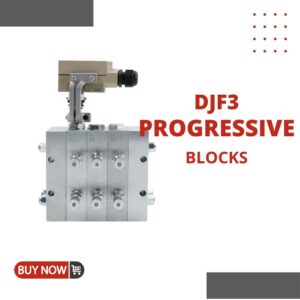
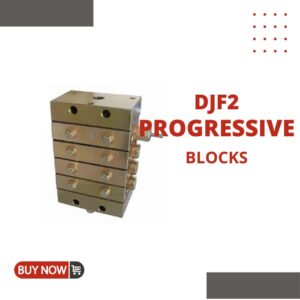
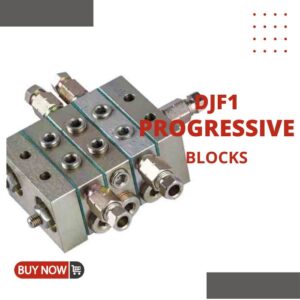
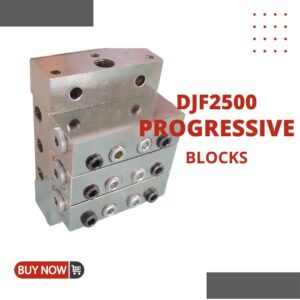
What a Mono Progressive Block Does
A mono progressive block is a single-piece metering device for centralized lubrication systems. Inside one solid body, plungers fire in a fixed sequence, each pushing a measured dose to its outlet. An outlet receives lubricant only after the previous plunger has fired, so the block works as one synchronized unit.
The outlet count is machined in at the factory, so a monobloc divider suits machines where the number of lubrication points is known and stable: manufacturing lines, automated machinery, and construction equipment such as wheel loaders and excavators.
How Progressive Distribution Works
Incoming lubricant drives the first plunger, which displaces a fixed volume to its outlet and uncovers the passage for the next one. The cycle runs through every plunger and restarts, delivering a controlled dose with minimal waste in an order that never changes.
The mechanism also acts as a monitor: if any outlet or downstream line is blocked, its plunger cannot move and the whole block stops cycling. Rising pressure or a stalled cycle indicator points straight to the fault. The trade-off: one blocked point starves every point on that block until cleared.
Technical Specifications
Standard models cover the following declared values:
| Specification | Value |
|---|---|
| Flow rate range | 0.1 to 5 L/min |
| Operating pressure | Up to 30 MPa (4,350 psi) |
| Body material | High-strength carbon steel or aluminum |
| Port threads | BSP, NPT, or SAE |
| Operating temperature | -30°C to +80°C (-22°F to +176°F) |
| Distribution method | Plunger-type, fixed sequence |
Dimensions vary with the outlet configuration; confirm the mounting footprint against the model drawing.
Where Monobloc Blocks Fit
Monobloc progressive blocks are commonly installed in:
- Industrial automation systems needing repeatable dosing at a fixed set of points
- Hydraulic and mechanical equipment needing precise fluid management
- Mobile machinery such as wheel loaders and excavators, where one compact block holds up well under vibration
In a central lubrication system, one block can serve a group of points, or several blocks can be zoned under one pump. A progressive block is not a grease manifold block: a manifold only splits flow without metering. For a full machine package built around an automatic pump, see the automatic grease pump system overview.
Selection and Service Boundaries
A monobloc block comes with fixed limits:
- The outlet count is fixed. To add points later, replace the block with a higher-outlet model or add a second block downstream.
- Every plunger must return to its original bore and orientation during service; swapped plungers break the firing sequence and can lock the block.
- Carbon steel and aluminum bodies suit different environments and weight budgets; confirm the material when ordering.
- Ports come in BSP, NPT, and SAE; match the thread standard to your existing fittings.
If your point count is still changing, send us your lubrication point list and we will map a block configuration to it.
Frequently Asked Questions
Should I choose a monobloc block or a modular stackable progressive divider?
Pick a monobloc block when your point count is fixed: a compact, rigid body with fewer joints. Pick a modular stackable divider when you expect to add or remove points later. If expansion is likely, plan for it now instead of replacing a fixed block later.
What lubricants can a mono progressive block handle?
It meters the oil or fluid grease delivered by the system pump. Very stiff greases may not move reliably through the internal passages, so confirm your lubricant viscosity with us before ordering.
What happens if one outlet or line gets blocked?
That plunger stops, and because each plunger drives the next, the whole block stops cycling until the blockage is cleared. The upside: rising pressure or a stalled indicator makes the fault easy to find.
Can I add more outlets to the block later?
No. The outlet count is machined into the body. To serve more points, replace the block with a higher-outlet model or add a second block downstream.
How do I know the block is cycling correctly?
Where a cycle indicator or monitoring pin is fitted, it moves once per sequence. Many systems wire it to the machine controller so a missed cycle raises an alarm.
Can the block be serviced, or must it be replaced?
It can be opened for inspection and cleaning. Every plunger must go back in its original bore and orientation; mixing the order disrupts the sequence. Keep the lubricant clean to reduce wear.
Which port thread should I order: BSP, NPT, or SAE?
Match the fittings already in your system: BSP is common on European and Asian machinery, NPT on North American equipment, SAE on many mobile machines. Confirm at order time; ports are machined into the body.
When should I pick the aluminum body instead of carbon steel?
Aluminum suits weight-sensitive mobile equipment and indoor machines; high-strength carbon steel suits harsh, high-vibration environments. If unsure, describe your conditions when requesting a quote.
Where is the block installed in the system?
Between the pump and the lubrication points. One block can feed a group of nearby points, or act as a master divider feeding smaller blocks in separate zones.
Who makes this block and how do I get pricing?
IsoHiTech Lubrication Systems supplies mono progressive blocks with pumps, fittings, and tubing for complete centralized systems. We were founded in 2023, engineering since 2006. Email inquiry@isohitech.com or request a quotation here for a configuration and price.